
Unveiling the Gospel After the Cross
Understanding the New Testament Journey
The dates and times recorded in the provided text are based on various interpretations and calculations of Biblical chronology. Here are some key points and calculations that are evident, along with areas that may need further explanation:
Ages of the Patriarchs: The calculation of time from Creation to the birth of Abraham is done by adding the ages of the Patriarchs when their first child is born. This method is straightforward and is used in Genesis to track the lineage from Adam to Abraham.
Period of the Flood: There is a suggestion that the period of the Flood is not meant to be included in the count. For example, Shem, born 100 years before the Flood, “begot” his first son two years after it, which should make him 102, but Genesis 11:10–11 specifies that he is only 100. This implies that time may have been suspended during the Flood. Rashi’s explanation that Japheth was born 100 years before the Flood and Shem two years later helps resolve this discrepancy.
Literal Chronology: A literal chronology would place the creation of the world around 4000 BCE and the Flood around 2300 BCE. Archbishop James Ussher’s well-known attempt to date Creation places it at 4004 BCE. Other alternatives include Isaac Newton’s 4000 BCE, Martin Luther’s 3961 BCE, the traditional Jewish date of 3760 BCE, and the traditional Greek Orthodox date of 5009 BCE. The dates given to subsequent events, such as the Flood, depend on this initial date.
Discrepancies and Interpretations: The differences among the Septuagint, Masoretic text, and Samaritan text highlight the challenges in creating a consistent chronology. For example, the Masoretic text sometimes contains discrepancies, such as stating that Saul came to the throne at the age of one and reigned for two years. These errors can be corrected by referencing other versions of the Bible, but for non-believers and scholars they call into question the idea that the Masoretic text is the inspired word of God.
External Sources: Very few events in the Bible are mentioned in outside sources, making it difficult to move from a relative chronology (X occured before Y did) to an absolute one (X occured in a known time and year).
Consistency: The Bible is not always consistent. For example, Exodus 12:40 states that the Israelites spent 430 years in Egypt, while Paul in Galatians 3:17 says the 430 years cover the period from Abraham to Moses.
Science and Literal Interpretation: Literal interpretation of the earlier parts of the Bible is in direct contradiction with modern scientific theory. This includes the age of the Earth and the timeline of human history, all occurring outside of time as we know it.
In summary, while the calculations and dates provided are based on various interpretations of Biblical texts, there are discrepancies and challenges that need to be addressed for some. Understanding the historical and cultural context, as well as the different versions of the Bible, can provide valuable insights into these calculations. We believe all scripture is God breathed as a pen for ready writers.
The prophetic use of time in the Bible often involves symbolic representations and specific principles. Here are some key aspects:
1. Day-Year Principle: In prophetic literature, a day can represent a year. This principle is seen in passages like Numbers 14:34, where the Israelites are told they will suffer for forty years, one year for each of the forty days they explored the land. Similarly, in Ezekiel 4:5-6, the prophet is instructed to lie on his side for a certain number of days to represent years of iniquity.
2. Prophetic Year: A prophetic year is often considered to be 360 days, consisting of 12 months of 30 days each. This can be determined by comparing Genesis 7:11 with Genesis 8:2-4, where the duration of the Flood is described. This 360-day year is also used in the prophecies of Daniel and Revelation, where periods like “time, times, and half a time” (3.5 years), “1,260 days,” and “42 months” are mentioned.
3. Symbolic Time Periods: Prophetic visions and dreams often contain symbolic time periods. For example, the “seventy weeks” prophecy in Daniel 9:24-27 is interpreted as seventy weeks of years, totaling 490 years. These symbolic periods are used to convey deeper meanings and divine messages.
4. God’s Perspective on Time: The Bible also teaches that God’s perception of time is different from ours. In 2 Peter 3:8, it says, “But, beloved, be not ignorant of this one thing, that one day is with the Lord as a thousand years, and a thousand years as one day.” This emphasizes the eternal nature of God and His plans.
These aspects illustrate the different ways time is represented in prophetic literature in the Bible.
Explore the profound journey of the Gospel after the resurrection of Jesus Christ, delving into the pivotal moments that shaped early Christianity.
Key Events in Early Christianity
Trace the significant milestones from Jesus’ intercessory prayers to John’s Revelation on Patmos.
Jesus' Intercessory Prayers
John 17: Jesus prays for His disciples and all believers.
Jesus' Betrayal, Trial, and Crucifixion
Matthew 27, Mark 15, Luke 23, John 18-19: The events leading to and including Jesus’ crucifixion.
Jesus' Resurrection
Matthew 28, Mark 16, Luke 24, John 20-21: Jesus rises from the dead, appearing to His disciples.
The Ascension
Acts 1: Jesus ascends to heaven, promising the Holy Spirit.
Significant Events in the Bible
BC, BCE
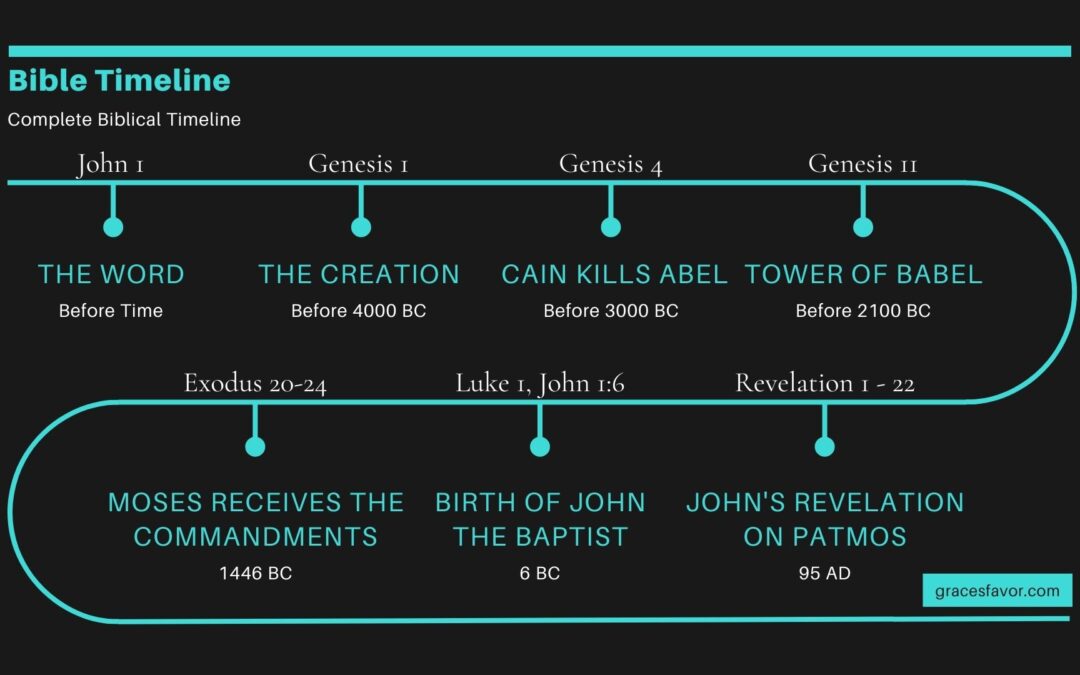
1800 The timeline begins with the era of Abraham and the Patriarchs, setting the foundation for the history of the Israelites. Moving forward to 1290, the pivotal events of the Exodus, led by Moses and Joshua, shape the identity of the Israelite people. The establishment of the Israelite monarchy in 1050 marks a significant shift with the rise of figures like Samuel and Saul, leading to the reign of King David and the prophet Nathan in 1000 BC. The division of the Kingdom in 922 between Rehoboam and Jeroboam I sets the stage for a period of political and religious turmoil, culminating in the reign of Ahab and Jezebel, as well as the prophetic ministries of Elijah and Elisha in 850 BC. The rise of Assyria as a dominant world power in 745 BC brings about new challenges and opportunities, accompanied by the prophetic voices of Amos, Hosea, and Jeroboam II. The fall of Samaria in 721 BC marks the end of the Northern Kingdom, leading to a time of political upheaval under King Ahaz and the prophet Isaiah. The Assyrian invasion of Judah in 701 BC, and the subsequent deliverance from Sennacherib, highlight the crucial roles of King Hezekiah and the prophets Isaiah and Micah. The reforms initiated by King Josiah in 621 BC pave the way for a period of religious revival and cultural transformation. The Battle of Carchemish in 605 BC signals the rise of the Babylonian empire, accompanied by the prophetic voices of Jeremiah and Habakkuk. The first deportation of Israelites to Babylon in 598 BC marks a turning point in the history of the Israelites, setting the stage for the eventual destruction of Jerusalem and the second deportation in 586 BC, with the prophetic voices of Jeremiah and Ezekiel guiding the people through these tumultuous times. The overthrow of the Babylonian Empire by the Persians in 538 BC brings hope for the exiled Israelites, leading to the return from exile under the reign of Cyrus. The rebuilding of the Jerusalem temple in 520 BC, led by figures like Haggai, Zechariah, and Zerubbabel, marks a period of restoration and renewal for the Israelite community. The reforms of Ezra in 450 BC signify the beginning of Judaism as a distinct religious identity, alongside figures like Nehemiah and the prophet Malachi, whose teachings shape the faith of the Israelites. The death of Alexander the Great in 323 BC ushers in a new era of Greek control under the Seleucids and the Ptolomies, setting the stage for further political and cultural changes in the region. The Macabbean Revolt in 167 BC, led by Judas Macabbee and chronicled in the Book of Daniel, showcases the resilience and determination of the Jewish people against oppressive forces. The Roman control of Palestine under the general Pompey in 63 BC marks a shift in political power, leading to the rule of Herod the Great and the birth of Jesus in 6-4 BC. The timeline transitions to the dawn of the Common Era, with the death and resurrection of Jesus Christ in 27-30 AD, followed by the impactful ministry of Paul from 33 to 60 AD. The Council of Jerusalem in 45 AD signifies a pivotal moment in the divergence of Christianity from its Jewish roots, as reflected in the earliest New Testament writings such as 1-2 Thessalonians by Paul, Barnabus, and Silas in 50 AD. The writing of the first Gospel by Mark in 60-70 AD, accompanied by the death of Paul, signals a new chapter in the spread of the Christian faith. The destruction of Jerusalem by the Roman general Titus in 70 AD marks a tragic end to the Jewish rebellion against Roman rule, while the last New Testament writings including the Gospel of John and Johannine literature in 90 AD continue to shape the beliefs and practices of the early Christian community. The Bar Kochba rebellion in 135 AD represents the final Jewish revolt against Rome, leading to the expulsion of Jews from Palestine and the enduring legacy of resistance and resilience in the face of adversity.
Our Mission
Welcome we are dedicated to exploring the BIBLICAL Gospel after the cross, based on the KJV and Scripture. Our aim is to provide a comprehensive understanding of the New Testament, emphasizing the importance of right-standing with God.
We strive to include all relevant chapters and verses within our text, making it easier for you to research and understand the Scriptures. Our focus is on the transformative power of the Gospel and its implications for believers today.
Join us as we delve into the richness of the New Testament, offering insights and devotional content that brings the Word of God to life. Together, let’s grow in our faith and understanding of the Scriptures.
Key Figures and Their Actions
- Jesus: Betrayal, Trial, Crucifixion
- Peter: Heals and Preaches
- Stephen: Speech, Stoning, and Death
- Saul: Persecutes the Church
- Paul: First Missionary Journey
- Philip: Baptizes the Ethiopian Eunuch
- Jesus: Resurrection
- Peter: Preaches to the Gentiles
- Paul: Writes to the Corinthians
- John: Writes Revelation on Patmos
- James: Writes His Letter
- Timothy: Receives Letters from Paul
- Barnabas: Sent to Antioch
- Philip: Preaches in Samaria
- Paul: Writes to the Romans
- Peter: Led from Prison by an Angel
- Paul: Writes to the Ephesians
- John: Writes His First Letter
A JOURNEY THROUGH SACRED HISTORY
The Just Live By Faith
Romans 1:16
“For I am not ashamed of the gospel of Christ, for it is the power of God to salvation for everyone who believes, for the Jew first and also for the Greek.”
Greetings to the Saints in Rome
Paul, a servant of Jesus Christ, called to be an apostle, separated unto the gospel of God, (Which he had promised afore by his prophets in the holy scriptures,) Concerning his Son Jesus Christ our Lord, which was made of the seed of David according to the flesh; And declared to be the Son of God with power, according to the spirit of holiness, by the resurrection from the dead: By whom we have received grace and apostleship, for obedience to the faith among all nations, for his name: Among whom are ye also the called of Jesus Christ:
To all that be in Rome, beloved of God, called to be saints: Grace to you and peace from God our Father, and the Lord Jesus Christ.
Paul’s Desire to Visit Rome
(1 Thessalonians 2:17-20)
First, I thank my God through Jesus Christ for you all, that your faith is spoken of throughout the whole world. For God is my witness, whom I serve with my spirit in the gospel of his Son, that without ceasing I make mention of you always in my prayers; Making request, if by any means now at length I might have a prosperous journey by the will of God to come unto you. For I long to see you, that I may impart unto you some spiritual gift, to the end ye may be established; That is, that I may be comforted together with you by the mutual faith both of you and me. Now I would not have you ignorant, brethren, that oftentimes I purposed to come unto you, (but was let hitherto,) that I might have some fruit among you also, even as among other Gentiles. I am debtor both to the Greeks, and to the Barbarians; both to the wise, and to the unwise. So, as much as in me is, I am ready to preach the gospel to you that are at Rome also.
I am Not Ashamed of the Gospel
For I am not ashamed of the gospel of Christ: for it is the power of God unto salvation to every one that believeth; to the Jew first, and also to the Greek. For therein is the righteousness of God revealed from faith to faith: as it is written, The just shall live by faith.
God’s Wrath against Sin
(Jeremiah 6:10-21; Jeremiah 25:15-33; Jonah 1:4-10; Acts 27:13-26)
For the wrath of God is revealed from heaven against all ungodliness and unrighteousness of men, who hold the truth in unrighteousness; Because that which may be known of God is manifest in them; for God hath shewed it unto them. For the invisible things of him from the creation of the world are clearly seen, being understood by the things that are made, even his eternal power and Godhead; so that they are without excuse: Because that, when they knew God, they glorified him not as God, neither were thankful; but became vain in their imaginations, and their foolish heart was darkened. Professing themselves to be wise, they became fools, And changed the glory of the uncorruptible God into an image made like to corruptible man, and to birds, and fourfooted beasts, and creeping things.
Wherefore God also gave them up to uncleanness through the lusts of their own hearts, to dishonour their own bodies between themselves: Who changed the truth of God into a lie, and worshipped and served the creature more than the Creator, who is blessed for ever. Amen.
For this cause God gave them up unto vile affections: for even their women did change the natural use into that which is against nature: And likewise also the men, leaving the natural use of the woman, burned in their lust one toward another; men with men working that which is unseemly, and receiving in themselves that recompence of their error which was meet.
And even as they did not like to retain God in their knowledge, God gave them over to a reprobate mind, to do those things which are not convenient; Being filled with all unrighteousness, fornication, wickedness, covetousness, maliciousness; full of envy, murder, debate, deceit, malignity; whisperers, Backbiters, haters of God, despiteful, proud, boasters, inventors of evil things, disobedient to parents, Without understanding, covenantbreakers, without natural affection, implacable, unmerciful: Who knowing the judgment of God, that they which commit such things are worthy of death, not only do the same, but have pleasure in them that do them.
In the book of Genesis, we learn about the creation of the world, the fall of humanity in the story of Adam and Eve, the great flood with Noah, and the confusion of tongues at the Tower of Babel. Moving on to the story of Abraham, we see God making promises and the birth of Isaac, followed by the testing of Abraham and the narratives of Isaac and Rebekah, Jacob and Esau, as well as Jacob’s children. The focus then shifts to Joseph being sold by his brothers and his time in Egypt. In the book of Exodus, we witness the birth of Moses, the burning bush encounter, the ten plagues, Israel’s rescue from Egypt, and the giving of the Ten Commandments. The journey continues with the entry into the Promised Land under Joshua’s leadership, the period of judges ruling Israel, the anointing of Saul as the first king, and the reigns of David and Solomon. The narrative also touches on the division of Israel and Judah, the rule of various kings, and the warnings of prophets about God’s impending judgment. The accounts of Israel’s exile by Assyria and Judah’s exile by Babylon are also shared, followed by the return of many Israelites to rebuild the land and temple in Ezra. The wait for the “new covenant” promised by the prophets leads us through Isaiah to Malachi, setting the stage for the birth, baptism, temptations, teachings, miracles, and ultimate sacrifice and resurrection of Jesus as depicted in the Gospels. The spread of Christianity post-resurrection, the growth of the early church, and the revelations received by John on Patmos in the book of Revelation conclude this profound journey through biblical history.
THE PATH TO LIBERATION AND GRACE
Creation — Genesis 1: God creates the world in six days, forming light, sky, land, seas, vegetation, celestial bodies, animals, and finally humans, declaring creation good and resting on the seventh day.
The Fall (Adam and Eve) — Genesis 3: Adam and Eve disobey God by eating from the forbidden tree of knowledge, leading to their awareness of good and evil, their loss of innocence, and their expulsion from Eden.
Noah and the Flood — Genesis 6: God decides to flood the earth to cleanse it of human wickedness, instructing Noah to build an ark to save his family and pairs of every animal species.
The Tower of Babel — Genesis 11: Humanity, unified by a single language, builds a tower to reach the heavens. God confounds their language, causing them to scatter across the earth.
The Call of Abram — Genesis 12: God calls Abram (later Abraham) to leave his homeland and promises to make him a great nation, bless him, and make his name great.
God makes promises to Abraham — Genesis 15: God formalizes His covenant with Abraham, promising him numerous descendants and the land of Canaan.
The Birth of Isaac — Genesis 21: Isaac, the long-awaited son of Abraham and Sarah, is born, fulfilling God’s promise of an heir.
Abraham tested — Genesis 22: God tests Abraham’s faith by asking him to sacrifice Isaac. Abraham obeys, but an angel intervenes, providing a ram as a substitute offering.
Isaac and Rebekah — Genesis 24: Abraham’s servant finds Rebekah to be Isaac’s wife through a sign from God, ensuring the continuation of the covenantal lineage.
Jacob and Esau — Genesis 25: Jacob and Esau, twins born to Isaac and Rebekah, represent two nations. Jacob, the younger, secures Esau’s birthright and blessing through cunning means.
Jacob’s children — Genesis 29: Jacob marries Leah and Rachel, and through them and their maidservants, has twelve sons who become the heads of the twelve tribes of Israel.
Joseph sold by his brothers — Genesis 37: Joseph, Jacob’s favored son, is sold into slavery by his jealous brothers, who deceive Jacob into believing Joseph is dead.
Joseph in Egypt — Genesis 39: Joseph rises to prominence in Potiphar’s house but is imprisoned after being falsely accused by Potiphar’s wife. He interprets dreams in prison, gaining favor.
Israel in slavery in Egypt — Exodus 1: The Israelites multiply in Egypt, and a new Pharaoh, fearing their numbers, enslaves them and orders the death of all male Hebrew infants.
The birth of Moses — Exodus 2: Moses is born, hidden by his mother to escape Pharaoh’s decree, and is later discovered and adopted by Pharaoh’s daughter.
Moses and the Burning Bush — Exodus 3: God appears to Moses in a burning bush, commissioning him to lead the Israelites out of Egypt and revealing His name as “I AM.”
The Ten Plagues — Exodus 7: God inflicts ten plagues upon Egypt to convince Pharaoh to release the Israelites, including blood, frogs, lice, flies, disease, boils, hail, locusts, darkness, and the death of firstborns.
God rescues Israel from Egypt — Exodus 12: The Israelites celebrate the Passover and leave Egypt, with God parting the Red Sea for their escape and drowning the pursuing Egyptian army.
God gives the Ten Commandments — Exodus 20: On Mount Sinai, God gives Moses the Ten Commandments, outlining laws and ethical principles for the Israelites.
Israel enters the Promised Land (Joshua) — Joshua 1: Joshua succeeds Moses as leader and begins the conquest of Canaan, following God’s instructions to take possession of the Promised Land.
Israel ruled by judges (Gideon, Deborah, Samson, etc.) — Judges 1: Israel is governed by a series of judges who lead and deliver the people from oppression, with notable figures including Gideon, Deborah, and Samson.
Israel gets its first king (Saul) — 1 Samuel 9: Saul is anointed as Israel’s first king by the prophet Samuel, chosen to lead the people and deliver them from their enemies.
David is anointed king — 1 Samuel 16: God chooses David, a young shepherd, to be the next king of Israel, anointing him through Samuel while Saul is still king.
David and Goliath — 1 Samuel 17: David defeats the giant Goliath with a sling and a stone, demonstrating his faith in God and beginning his rise to prominence.
David becomes king — 2 Samuel 5: David is anointed king over all Israel, establishing Jerusalem as his capital and uniting the tribes of Israel under his rule.
Solomon becomes king — 1 Kings 1: Solomon, David’s son, is crowned king following David’s death, securing his reign and beginning a period of prosperity and wisdom.
Israel is divided: Israel and Judah — 1 Kings 12: After Solomon’s death, the kingdom divides into the northern kingdom of Israel and the southern kingdom of Judah, leading to political and religious fragmentation.
NEW AGE OF GRACE
Kings rule (mostly bad) for 345 years — 1 Kings 13 and following: Both Israel and Judah experience a succession of kings, most of whom lead the people away from God, resulting in moral and spiritual decline.
Prophets warn Israel of God’s coming punishment on the nation (while also promising a glorious future beyond judgment) — Chart of Israel’s and Judah’s Kings and Prophets: Various prophets, such as Isaiah and Jeremiah, forewarn of impending judgment due to the nation’s sins, yet also offer hope for future restoration and a new covenant.
Exile, part one: Israel (the northern half), conquered by Assyria — 2 Kings 17: The northern kingdom of Israel falls to Assyria, leading to the deportation of its people and the loss of its identity.
Exile, part two: Judah (the southern half), conquered by Babylon — 2 Kings 25: The southern kingdom of Judah is conquered by Babylon, resulting in the destruction of Jerusalem and the Temple, and the exile of its inhabitants.
Many Israelites return to Israel to rebuild the demolished land and temple — Ezra 1: After the Persian conquest of Babylon, King Cyrus allows the Israelites to return to Jerusalem and begin rebuilding the Temple.
The completion of the new temple — Ezra 6: The reconstruction of the Temple in Jerusalem is completed, marking a significant moment of restoration for the returning exiles.
Lots of waiting for the “new covenant,” which the prophets promised — Isaiah to Malachi: The period between the Old and New Testaments involves anticipation of the new covenant foretold by prophets, promising future redemption and renewal.
Jesus is born — Matthew 1 and Luke 2: Jesus Christ is born to Mary and Joseph in Bethlehem, marking the fulfillment of prophecies about the Messiah’s coming.
Baptism of Jesus — Matthew 3; Mark 1; and Luke 3: Jesus is baptized by John the Baptist in the Jordan River, signifying the beginning of His public ministry and receiving divine affirmation.
Temptation of Jesus — Matthew 4; Mark 1; and Luke 4: Jesus is tempted by Satan in the desert but resists, demonstrating His obedience and preparation for His mission.
Sermon on the Mount — Matthew 5: Jesus delivers the Sermon on the Mount, offering teachings on ethics, spirituality, and the nature of God’s kingdom, including the Beatitudes.
The Transfiguration — Matthew 17; Mark 9; and Luke 9: Jesus is transfigured on a mountain, revealing His divine glory to Peter, James, and John, and conversing with Moses and Elijah.
Jesus Affirms he is the Son of God — John 9: Jesus heals a man born blind and asserts His divine identity as the Son of God, challenging the religious authorities.
The Triumphal Entry — Matthew 21; Mark 11; Luke 19; and John 12: Jesus enters Jerusalem on a donkey, greeted by crowds with palm branches, symbolizing His kingship and the fulfillment of prophecy.
The Last Supper — Matthew 26; Mark 14; Luke 22; and John 13: Jesus shares the Passover meal with His disciples, instituting the Lord’s Supper (Eucharist) and predicting His impending betrayal and death.
Jesus’ Betrayal, Trial, Crucifixion — Matthew 27; Mark 15; Luke 23; and John 18: Jesus is betrayed by Judas, tried before religious and Roman authorities, and crucified, fulfilling His mission of atonement for sin.
Jesus’ Resurrection — Matthew 28; Mark 16; Luke 24; and John 20: Jesus rises from the dead on the third day after His crucifixion, demonstrating victory over sin and death, and appearing to His disciples.
The Ascension — Acts 1: Jesus ascends to heaven in the presence of His disciples, promising them the coming of the Holy Spirit and instructing them to be His witnesses to the ends of the earth.
The Holy Spirit Comes at Pentecost — Acts 2: The Holy Spirit descends upon the apostles at Pentecost, enabling them to speak in various languages and marking the beginning of the Christian church.
The church’s first martyr — Acts 6: Stephen, one of the seven deacons chosen to serve the church, is arrested and becomes the first Christian martyr when he is stoned to death for his faith.
Saul’s Conversion — Acts 9: Saul of Tarsus, a persecutor of Christians, has a dramatic encounter with Jesus on the road to Damascus and is converted, later becoming known as Paul, a key apostle.
The growth of the church — The book of Acts: The early Christian church expands rapidly through the apostles’ preaching, missionary journeys, and the work of early believers, despite facing persecution and challenges.
John’s Revelation on Patmos — The book of Revelation: The Apostle John receives a series of visions while exiled on the island of Patmos, revealing symbolic messages about the end times, the final victory of Christ, and the promise of a new heaven and new earth.
SHARE THE GIFT OF GRACE
Deepen Your Understanding
Discover the profound truths of the BIBLICAL Gospel and understand the essence of right-standing in GOD. Dive into the chapters and verses listed on our website for a comprehensive study and enrich your spiritual journey. Engage with the scriptures and let the Holy Spirit guide you in your devotion.
EMBRACED BY GRACE LIVING IN HIS RIGHTEOUSNESS
UNDERSTANDINGS OF GOD'S RIGHTEOUSNESS
“God made him who had no sin to be sin for us, so that in him we might become the righteousness of God” (2 Corinthians 5:21).
One of the profound benefits of salvation is that you are endowed with the righteousness of God.
This concept may seem lofty at first glance, but as we explore its depths, we discover just how significant it truly is.
So, I pose this question: do you genuinely grasp the full meaning of righteousness, particularly the righteousness that belongs to God? To shed light on this topic, I want to elucidate three essential aspects of God’s righteousness.
At its core, the righteousness of God signifies His absolute justice, holiness, and fairness in every action and decision He makes. This characteristic lies at the heart of who He is, a truth that resonates throughout the scriptures. For instance, in Psalm 145:17, we read that the Lord is righteous in all his ways and faithful in all he does, emphasizing that God’s actions are inherently right and just, showcasing His unwavering dedication to moral perfection and equity.
Furthermore, biblical commentary underscores that God’s righteousness transcends mere theory; it is actively demonstrated in His interactions with humanity. Moses captures this truth in Deuteronomy 32:4, affirming that God is the Rock, whose works are flawless, and whose ways are entirely just. This passage reveals that God’s righteousness is not just an abstract idea but is evident in His perfect deeds and just judgments.
Additionally, we see God’s righteousness vividly portrayed in His response to human sin and His generous provision of salvation. Romans 3:25-26 highlights how God presented Christ as a sacrifice of atonement through His blood, to be received through faith, thereby illustrating His righteousness by addressing the sins committed before while ensuring justice and also justifying those who believe in Jesus. In the context of 2 Corinthians 5:21, righteousness is understood as receiving God’s approval, meaning that when God looks upon you, He sees you as a bearer of His righteousness and considers you justified in His sight. Reflecting on this profound truth can lead to an overwhelming sense of joy because it reveals that God sees you and approves of you, prompting the urge to express your gratitude with a shout of praise, or at the very least, some heartfelt acknowledgment of His goodness. Understanding the definition of God’s righteousness is indeed marvelous, yet it calls for a deeper exploration. Therefore, I would like to share with you three key insights about the righteousness of God.
1. God’s righteousness is not something we achieve through our own efforts; rather, it is a gift bestowed upon us through a divine exchange.
God’s righteousness and the way He views you as approved is truly remarkable because no amount of effort on your part can ever earn His approval, and this reality is not just extraordinary but also profoundly liberating. It frees you from the relentless pursuit of perfection and the constant anxiety of measuring up. Picture the exhausting strain of navigating life filled with doubt about whether you have done enough to gain God’s favor. This heavy burden is simply too much to bear and ultimately distracts you from experiencing the grace and love that God readily offers. I genuinely want you to let go of that pressure and embrace the peace that comes from knowing that you are already accepted.
To fully grasp the depth of God’s righteousness, one must understand that it is a divine gift freely bestowed upon us rather than something we can earn through our own efforts. This remarkable exchange unfolds in a profound way: Christ, in his immense love, took upon himself the weight of our sins, embodying them fully and completely, and in return, he offers us his own righteousness, pure and unblemished. To be seen as righteous in the eyes of God, it is essential to wholeheartedly place all of your sins onto Christ, embracing the incredible gift of his righteousness. Although this may seem difficult to comprehend at times, as it feels almost too wondrous to believe, I assure you it is indeed true. If you open your heart and permit God to work in your life, he will graciously take your sins and exchange them for his perfect righteousness, which, my friend, is an opportunity beyond measure.
2. The righteousness of God cannot be bought or earned, it is paid for
The incredible truth about God’s righteousness is that it comes to you entirely free of charge, yet it exacted an unimaginable cost from Jesus. The reality is that the value of your righteousness is so immense that no amount of wealth could ever secure it for you. This is indeed uplifting news because God does not require you to pay for something that is beyond your reach. Instead, the price has already been fully covered, allowing you to receive this precious gift without the burden of payment.
“So, now that we have been made righteous by his blood, we can be even more certain that we will be saved from God’s wrath through him” (Romans 5:9).
Through the sacrifice of Jesus Christ, you are made righteous and justified, as the timeless hymn expresses.
“There is a fountain filled with blood drawn from Emmanuel’s veins. And sinners plunged beneath that flood lose all their guilty stains.”
You and I were guilty as sin, completely deserving of the consequences of our actions and separated from the purity of God. Yet there was a savior, Jesus Christ, who willingly descended from the glory of heaven, offering Himself as a sacrifice and shedding His precious blood so that all our filthy, sinful stains would be washed away, cleansing us completely and allowing us to be declared righteous in the eyes of God. If you have truly received Jesus Christ as your Lord and Savior, then in this very moment, right now, you stand righteous before God, free from all guilt and shame. The weight of all our wrongdoings has been lifted, paid in full by the blood of Jesus, which has been graciously applied to your account, ensuring that your sins are no longer held against you. There is nothing more required for your redemption and acceptance in God’s family, for His love and grace have transformed your standing forever.
3. The righteousness of God transcends the fleeting moments of time and stands forever.
It’s important to recognize that many Christians face challenges with sin, repentance, forgiveness, and understanding God’s righteousness. However, it’s crucial to grasp that when God declares you righteous, that declaration is not fleeting; it is everlasting. In a courtroom, if a case is dismissed with prejudice, it signifies a permanent closure—it cannot be reopened. Similarly, when God pronounces you righteous, He is effectively dismissing your original sin case once and for all, sealing it so that it can never be brought up again. Reflect on the wisdom found in the book of Romans.
“But now apart from the law the righteousness of God has been made known, to which the Law and the Prophets testify. This righteousness is given through faith in Jesus Christ to all who believe. There is no difference between Jew and Gentile, for all have sinned and fall short of the glory of God, and all are justified freely by his grace through the redemption that came by Christ Jesus” (Romans 3:21-24).
Through God’s justification or declaration of righteousness over your life, you have been made right in his sight, a profound truth that carries significance both in the present and for all eternity. This understanding of God’s righteousness is foundational, as it assures you that the issue of original sin has been fully addressed, granting you not only the status of being the righteousness of God but also elevating you to the realm of his cherished possession. This means that you are valued and loved, belonging to him not just temporarily but for an everlasting relationship that transcends time and circumstance.
“But you are a chosen people, a royal priesthood, a holy nation, God’s special possession, that you may declare the praises of him who called you out of darkness into his wonderful light. Once you were not a people, but now you are the people of God; once you had not received mercy, but now you have received mercy” (1 Peter 2:9-10).
How Does God’s Righteousness Apply When I Sin?
Understanding the significance of sin in the context of God’s declaration of righteousness is crucial. As previously highlighted, one key aspect of God’s righteousness is its direct engagement with your original sin. This is the very sin that created a barrier between you and God, the one that could have led to eternal separation from Him. However, this sin has been confronted, resolved, and ultimately dismissed with prejudice. That’s how Paul could righteously write in Romans 8:1 “Therefore, there is now no condemnation for those who are in Christ Jesus.”
He penned these profound words immediately following a discussion about the universal struggle we encounter with our sinful nature, shedding light on the inner battles that each of us faces in our daily lives. in Romans 7. He expressed it this way
“For I know that good itself does not dwell in me, that is, in my sinful nature. For I have the desire to do what is good, but I cannot carry it out. For I do not do the good I want to do, but the evil I do not want to do — this I keep on doing” (Romans 7:18-19).
You can see the internal battle that Paul recognizes the body of Christ(church) is facing, and I resonate with that struggle deeply. He openly recognizes that while we are in this physical body, we will inevitably encounter difficulties stemming from our sinful nature. However, it is essential to understand that these ongoing struggles do not undermine your position of righteousness before God. In truth, the word condemnation carries with it the notion of a penalty imposed after a trial has taken place. Yet, because you embody the righteousness of God, you have already faced that trial and emerged with a verdict of not guilty; thus, there is no eternal penalty that awaits you. Embrace this truth with confidence as it assures you of your rightful standing with God, regardless of your battles.
Does this mean I have permission to sin?
It does not. I believe that someone who interprets God’s grace or His pronouncement of righteousness as permission to sin lacks a true grasp of justification and grace. One must question whether they have genuinely accepted Christ in their life. Although sin does not alter your status of righteousness, it does hinder your capacity to maintain a close relationship with God. This is why it is important to repent swiftly when you sin, as it helps to preserve the connection between you and God.
It is important to recognize that while sin may not sever your declaration of faith or lead to condemnation, it can still result in significant consequences in your earthly life. These consequences stem from the choices you make and can affect various aspects of your existence. However, it is crucial to remember that the repercussions you experience are temporary rather than eternal, as your ultimate salvation has already been secured through Christ’s sacrifice. Therefore, relying on the guidance and strength of the Holy Spirit, strive diligently to steer clear of sin in all circumstances. Yet, if you stumble and find yourself ensnared by sin, do not hesitate to repent swiftly and sincerely. This act of repentance is vital for preserving the precious and beautiful fellowship you have with the Father, enabling you to return to a place of grace and intimacy in your relationship with Him.
To explore the concept of righteousness, it’s essential to recognize that it’s a profound aspect of God’s nature. Rather than viewing righteousness as a goal to attain or a state to achieve over time, understand that it is an integral part of your identity once you are embraced by God’s grace. When you are declared right with God and receive His approval, you inherently possess that righteousness, meaning that you do not need to strive to become more righteous; instead, you are already complete in that standing before Him.
In contemplating this question, I would frame it like this: how can I embody the character of Christ more fully? As a believer, your aspiration should be to emulate Christ in your thoughts, actions, and overall demeanor. By doing so, you become a reflection of His essence in the world. This is ultimately what God wishes for us in our lives.
Instead of striving to be more righteous, recognize that you already possess this quality through your faith; the focus should be on becoming more like Christ in your daily life. Embrace the journey of transformation, knowing that the Holy Spirit is present to guide and support you every step of the way. Invite His presence into your heart by praying for the Holy Spirit to come, and watch as He empowers you to reflect the love and grace of Christ in all that you do.
“I will give you a new heart and put a new spirit in you; I will remove from you your heart of stone and give you a heart of flesh. And I will put my Spirit in you and move you to follow my decrees and be careful to keep my laws” (Ezekiel 36:26-27).
A Closing Thought; As we conclude this journey together, it’s important to reflect on the insights we’ve gained and the connections we’ve formed. Each ending paves the way for new beginnings, offering us the opportunity to learn from our experiences and grow in ways we might not have anticipated. Embracing these moments allows us to carry forward the wisdom gained, shaping a brighter path ahead that is filled with potential and purpose. Remember that every ending is merely a stepping stone toward future possibilities, inviting us to remain curious and open to what lies beyond.
Today my friends, you are declared righteous. Now I challenge you to do one thing. Live like it. With the help of the Holy Spirit live like one who has been tried and found not guilty, because that is what you are.
Understanding the righteousness of God can be complex, but perhaps one of the most vital truths is realizing that you are cherished in His eyes. Embrace today with the assurance that if you have accepted Christ, you are both gifted with and embody the righteousness of God. You are free from doubt and can rest in this certainty forever.