No Man Can Serve Two Masters

No Man Can Serve Two Masters

Discover Your Path

Embrace Your Faith Journey

Join us in exploring the timeless wisdom of the Bible and find guidance for your spiritual journey.

​Exploring the Divine and the Material: God and Money

The Fundamental Conflict: God vs. Mammon
Jesus’ teaching in Matthew 6:24 is clear: “No man can serve two masters: for either he will hate the one, and love the other; or else he will hold to the one, and despise the other. Ye cannot serve God and mammon.” Here, mammon represents wealth or material gain, which competes with God for our devotion. This conflict isn’t just about choices between money and faith but about our deepest allegiances and priorities.

Implication for Today: In a world where financial success is often idolized, this teaching challenges us to evaluate our true loyalties. Are we prioritizing material wealth over spiritual values? The principle remains relevant as we grapple with economic pressures and societal expectations.

Treasures in Heaven vs. Earth
Matthew 6:19-21 advises: “Lay not up for yourselves treasures upon earth… But lay up for yourselves treasures in heaven… For where your treasure is, there will your heart be also.” This contrast between earthly and heavenly treasures emphasizes the impermanence of material wealth versus the eternal value of spiritual investments.

Implication for Today: As consumerism drives much of modern life, this teaching encourages us to reflect on where we are investing our time, energy, and resources. True fulfillment comes from aligning our lives with eternal values rather than temporary gains.

Authenticity in Acts of Service
Jesus teaches in Matthew 6:1-4 that acts of charity should be done in secret to avoid seeking human praise. “Let not thy left hand know what thy right hand doeth… Thy Father which seeth in secret shall reward thee openly.” This principle is about authenticity in our actions—serving others out of genuine compassion rather than for recognition.

Implication for Today: In an era of social media and public displays of generosity, this teaching calls us to question our motives. Are our acts of service driven by a desire for approval, or are they motivated by true love and humility?

The Single Eye: Focus and Light
In Luke 11:33-36, Jesus uses the metaphor of the eye to describe spiritual focus: “If therefore thine eye be single, thy whole body shall be full of light.” A focused, single-hearted devotion to God ensures that our lives are illuminated by spiritual clarity rather than darkness.

Implication for Today: This teaching invites us to assess whether our focus is on God or on material distractions. A clear, undivided vision aligns us with divine purpose and fosters a life of integrity and purpose.

The Dangers of Wealth
1 Timothy 6:9-10 warns of the perils of pursuing wealth: “But they that will be rich fall into temptation and a snare… For the love of money is the root of all evil.” This passage highlights the potential for material wealth to lead to destructive desires and spiritual pitfalls.

Implication for Today: With financial ambitions often seen as the path to success, this warning reminds us of the potential spiritual dangers of excessive focus on wealth. It’s a call to balance financial aspirations with spiritual integrity.

Choosing Whom to Serve
Joshua 24:15 challenges us to “Choose you this day whom ye will serve.” This is a call to make a conscious decision about our primary allegiance—whether to God or to other competing values.

Implication for Today: In a world full of competing priorities, this call is about making deliberate choices that align with our deepest values. It’s a reminder to evaluate our commitments and ensure that our lives reflect our highest beliefs.

​Conclusion

These teachings about money and God invite us to examine our priorities and practices critically. They urge us to invest in what is eternal rather than transient, to act with genuine motives, and to focus our lives on spiritual rather than material gains. As we navigate contemporary challenges, these principles offer timeless guidance for living a balanced and faith-centered life.

Scriptural Insights

Scripture underscores the profound conflict between serving God and pursuing wealth, as seen in Matthew 6:24: “No man can serve two masters… Ye cannot serve God and mammon.” This dichotomy highlights the fundamental choice between devoting our lives to spiritual values and succumbing to the lure of material gain. The Bible warns that wealth can become an idol, drawing us away from our true allegiance to God, emphasizing that our treasures and priorities should align with divine principles rather than transient earthly rewards.

Faithful Living

Faithful living involves prioritizing our relationship with God over the pursuit of material wealth. By following the teachings of Matthew 6:19-21, which call us to “lay up for yourselves treasures in heaven,” we commit to investing our time, resources, and energy in ways that reflect eternal values. This commitment requires us to live authentically and generously, not for personal gain or recognition, but out of genuine love and devotion, embodying the principle that our true reward lies in a life aligned with divine purpose.

Community Support

In the context of community support, choosing God over Mammon means fostering a culture of mutual aid and selflessness. As guided by Matthew 6:1-4, our acts of charity should be driven by compassion rather than the desire for praise, creating a supportive environment where individuals uplift each other out of genuine care. This approach nurtures a community where resources are shared, needs are met, and relationships are strengthened through acts of kindness that reflect our collective commitment to higher spiritual values.

Spiritual Growth

Spiritual growth flourishes when we prioritize our relationship with God over material pursuits. By focusing on Matthew 6:33’s call to “seek ye first the kingdom of God,” we align our lives with divine purpose and cultivate a deeper, more meaningful faith. This growth involves developing a clear, undivided devotion to God, allowing us to navigate life’s challenges with a sense of spiritual clarity and integrity. As we grow spiritually, we learn to place our trust in God’s provision rather than in the fleeting promises of wealth, leading to a more fulfilled and purpose-driven life.

Our Mission

Our mission is to promote biblical teachings and help individuals achieve right standing with God. We are dedicated to providing in-depth scriptural insights based on the King James Version of the Bible, encouraging a loving devotional life, and fostering a community of believers who are alive in Jesus through the Holy Spirit. We aim to make the Bible accessible and understandable, listing all chapters and verses for easier research and deeper understanding.

Choose Whom to Serve

A Call to Devotion

Joshua 24:15 – And if it seem evil unto you to serve the LORD, choose you this day whom ye will serve; whether the gods which your fathers served that were on the other side of the flood, or the gods of the Amorites, in whose land ye dwell: but as for me and my house, we will serve the LORD.

1 Kings 18:21 – And Elijah came unto all the people, and said, How long halt ye between two opinions? if the LORD be God, follow him: but if Baal, then follow him. And the people answered him not a word.

Matthew 4:10 – Then saith Jesus unto him, Get thee hence, Satan: for it is written, Thou shalt worship the Lord thy God, and him only shalt thou serve.

Romans 6:16-22 – Know ye not, that to whom ye yield yourselves servants to obey, his servants ye are to whom ye obey; whether of sin unto death, or of obedience unto righteousness?

Common Questions

u

How can I apply these teachings in my daily life?

Start by incorporating prayer and scripture reading into your daily routine. Reflect on the verses and seek ways to live out their principles in your actions and decisions.

u

What if I struggle to understand certain verses?

It’s normal to find some verses challenging. Consider using a study Bible, joining a Bible study group, or seeking guidance from a knowledgeable mentor or pastor.

u

How do I know if I'm interpreting the verses correctly?

Pray for wisdom and discernment. Cross-reference with other scriptures and consult trusted biblical commentaries or teachings to gain a deeper understanding.

u

Can these teachings help me in times of crisis?

Absolutely. The Bible offers comfort, guidance, and hope. Turn to scripture for reassurance and strength during difficult times, and trust in God’s plan for you.

u

How can I share these teachings with others?

Share your personal experiences and how the teachings have impacted your life. Use social media, join discussion groups, or simply have conversations with friends and family.

u

What resources are available for deeper study?

There are many resources available, including study Bibles, commentaries, online courses, and local church study groups. Explore these to deepen your understanding.

u

How do I stay committed to living a life aligned with biblical principles?

Stay connected with a faith community, continue studying the Bible, and regularly pray for strength and guidance. Surround yourself with supportive individuals who share your commitment.

u

What should I do if I feel distant from God?

Take time to pray and seek God’s presence. Read and meditate on scripture, and consider speaking with a spiritual advisor to help you reconnect with your faith.

u

How can I teach my children about these principles?

Incorporate Bible stories into their daily routine, encourage them to ask questions, and lead by example. Create a supportive environment where they can grow in their faith.

Matthew 6:24

“No man can serve two masters: for either he will hate the one, and love the other; or else he will hold to the one, and despise the other. Ye cannot serve God and mammon.”

1 Timothy 6:17

Charge them that are rich in this world, that they be not highminded, nor trust in uncertain riches, but in the living God, who giveth us richly all things to enjoy;

2 Timothy 4:10

For Demas hath forsaken me, having loved this present world, and is departed unto Thessalonica; Crescens to Galatia, Titus unto Dalmatia.

Romans 6:16-22

Know ye not, that to whom ye yield yourselves servants to obey, his servants ye are to whom ye obey; whether of sin unto death, or of obedience unto righteousness?But God be thanked, that ye were the servants of sin, but ye have obeyed from the heart that form of doctrine which was delivered you.Being then made free from sin, ye became the servants of righteousness.I speak after the manner of men because of the infirmity of your flesh: for as ye have yielded your members servants to uncleanness and to iniquity unto iniquity; even so now yield your members servants to righteousness unto holiness.For when ye were the servants of sin, ye were free from righteousness.What fruit had ye then in those things whereof ye are now ashamed? for the end of those things is death.But now being made free from sin, and become servants to God, ye have your fruit unto holiness, and the end everlasting life.

Zephaniah 1:5

And them that worship the host of heaven upon the housetops; and them that worship and that swear by the LORD, and that swear by Malcham;

Matthew 4:10

Then saith Jesus unto him, Get thee hence, Satan: for it is written, Thou shalt worship the Lord thy God, and him only shalt thou serve.

Ezekiel 20:39

As for you, O house of Israel, thus saith the Lord GOD; Go ye, serve ye every one his idols, and hereafter also, if ye will not hearken unto me: but pollute ye my holy name no more with your gifts, and with your idols

2 Kings 17:41

So these nations feared the LORD, and served their graven images, both their children, and their children’s children: as did their fathers, so do they unto this day.

2 Kings 17:33-34

They feared the LORD, and served their own gods, after the manner of the nations whom they carried away from thence.Unto this day they do after the former manners: they fear not the LORD, neither do they after their statutes, or after their ordinances, or after the law and commandment which the LORD commanded the children of Jacob, whom he named Israel;

1 Samuel 7:3

And Samuel spake unto all the house of Israel, saying, If ye do return unto the LORD with all your hearts, then put away the strange gods and Ashtaroth from among you, and prepare your hearts unto the LORD, and serve him only: and he will deliver you out of the hand of the Philistines.

Joshua 24:19-20

And Joshua said unto the people, Ye cannot serve the LORD: for he is an holy God; he is a jealous God; he will not forgive your transgressions nor your sins.If ye forsake the LORD, and serve strange gods, then he will turn and do you hurt, and consume you, after that he hath done you good.

1 Kings 18:21

And Elijah came unto all the people, and said, How long halt ye between two opinions? if the LORD be God, follow him: but if Baal, then follow him. And the people answered him not a word.

Joshua 24:15

And if it seem evil unto you to serve the LORD, choose you this day whom ye will serve; whether the gods which your fathers served that were on the other side of the flood, or the gods of the Amorites, in whose land ye dwell: but as for me and my house, we will serve the LORD.

1 John 2:15-16

Love not the world, neither the things that are in the world. If any man love the world, the love of the Father is not in him.For all that is in the world, the lust of the flesh, and the lust of the eyes, and the pride of life, is not of the Father, but is of the world.

1 Timothy 6:9-10

But they that will be rich fall into temptation and a snare, and into many foolish and hurtful lusts, which drown men in destruction and perdition.For the love of money is the root of all evil: which while some coveted after, they have erred from the faith, and pierced themselves through with many sorrows.

Luke 16:9

And I say unto you, Make to yourselves friends of the mammon of unrighteousness; that, when ye fail, they may receive you into everlasting habitations.

Luke 16:13

No servant can serve two masters: for either he will hate the one, and love the other; or else he will hold to the one, and despise the other. Ye cannot serve God and mammon.

James 4:4

Ye adulterers and adulteresses, know ye not that the friendship of the world is enmity with God? whosoever therefore will be a friend of the world is the enemy of God.

Luke 16:11

If therefore ye have not been faithful in the unrighteous mammon, who will commit to your trust the true riches?

Join Our Spiritual Journey

In essence, the teachings of Jesus about money and wealth challenge us to reflect deeply on our values, priorities, and actions. They call for a realignment of our lives to ensure that we are not serving mammon at the expense of our spiritual well-being. By embracing these principles, we can navigate the complexities of modern life with a clear focus on what truly matters, ensuring that our pursuit of financial stability does not overshadow our commitment to God.
God and Money: A Scriptural Reflection for Today and Tomorrow

Immerse yourself in the profound teachings of the Bible. Subscribe to our newsletter for weekly insights, devotionals, and exclusive resources to deepen your faith and understanding. Take the next step in your spiritual journey with us.

Time In A Bible

Time In A Bible

Unveiling the Gospel After the Cross

Understanding the New Testament Journey

The dates and times recorded in the provided text are based on various interpretations and calculations of Biblical chronology. Here are some key points and calculations that are evident, along with areas that may need further explanation:

Ages of the Patriarchs: The calculation of time from Creation to the birth of Abraham is done by adding the ages of the Patriarchs when their first child is born. This method is straightforward and is used in Genesis to track the lineage from Adam to Abraham.
Period of the Flood: There is a suggestion that the period of the Flood is not meant to be included in the count. For example, Shem, born 100 years before the Flood, “begot” his first son two years after it, which should make him 102, but Genesis 11:10–11 specifies that he is only 100. This implies that time may have been suspended during the Flood. Rashi’s explanation that Japheth was born 100 years before the Flood and Shem two years later helps resolve this discrepancy.
Literal Chronology: A literal chronology would place the creation of the world around 4000 BCE and the Flood around 2300 BCE. Archbishop James Ussher’s well-known attempt to date Creation places it at 4004 BCE. Other alternatives include Isaac Newton’s 4000 BCE, Martin Luther’s 3961 BCE, the traditional Jewish date of 3760 BCE, and the traditional Greek Orthodox date of 5009 BCE. The dates given to subsequent events, such as the Flood, depend on this initial date.
Discrepancies and Interpretations: The differences among the Septuagint, Masoretic text, and Samaritan text highlight the challenges in creating a consistent chronology. For example, the Masoretic text sometimes contains discrepancies, such as stating that Saul came to the throne at the age of one and reigned for two years. These errors can be corrected by referencing other versions of the Bible, but for non-believers and scholars they call into question the idea that the Masoretic text is the inspired word of God.
External Sources: Very few events in the Bible are mentioned in outside sources, making it difficult to move from a relative chronology (X occured before Y did) to an absolute one (X occured in a known time and year).
Consistency: The Bible is not always consistent. For example, Exodus 12:40 states that the Israelites spent 430 years in Egypt, while Paul in Galatians 3:17 says the 430 years cover the period from Abraham to Moses.
Science and Literal Interpretation: Literal interpretation of the earlier parts of the Bible is in direct contradiction with modern scientific theory. This includes the age of the Earth and the timeline of human history, all occurring outside of time as we know it.

In summary, while the calculations and dates provided are based on various interpretations of Biblical texts, there are discrepancies and challenges that need to be addressed for some. Understanding the historical and cultural context, as well as the different versions of the Bible, can provide valuable insights into these calculations. We believe all scripture is God breathed as a pen for ready writers.

The prophetic use of time in the Bible often involves symbolic representations and specific principles. Here are some key aspects:

1. Day-Year Principle: In prophetic literature, a day can represent a year. This principle is seen in passages like Numbers 14:34, where the Israelites are told they will suffer for forty years, one year for each of the forty days they explored the land. Similarly, in Ezekiel 4:5-6, the prophet is instructed to lie on his side for a certain number of days to represent years of iniquity.

2. Prophetic Year: A prophetic year is often considered to be 360 days, consisting of 12 months of 30 days each. This can be determined by comparing Genesis 7:11 with Genesis 8:2-4, where the duration of the Flood is described. This 360-day year is also used in the prophecies of Daniel and Revelation, where periods like “time, times, and half a time” (3.5 years), “1,260 days,” and “42 months” are mentioned.

3. Symbolic Time Periods: Prophetic visions and dreams often contain symbolic time periods. For example, the “seventy weeks” prophecy in Daniel 9:24-27 is interpreted as seventy weeks of years, totaling 490 years. These symbolic periods are used to convey deeper meanings and divine messages.

4. God’s Perspective on Time: The Bible also teaches that God’s perception of time is different from ours. In 2 Peter 3:8, it says, “But, beloved, be not ignorant of this one thing, that one day is with the Lord as a thousand years, and a thousand years as one day.” This emphasizes the eternal nature of God and His plans.

These aspects illustrate the different ways time is represented in prophetic literature in the Bible.

Explore the profound journey of the Gospel after the resurrection of Jesus Christ, delving into the pivotal moments that shaped early Christianity.

Key Events in Early Christianity

Trace the significant milestones from Jesus’ intercessory prayers to John’s Revelation on Patmos.

Jesus' Intercessory Prayers

John 17: Jesus prays for His disciples and all believers.

Jesus' Betrayal, Trial, and Crucifixion

Matthew 27, Mark 15, Luke 23, John 18-19: The events leading to and including Jesus’ crucifixion.

Jesus' Resurrection

Matthew 28, Mark 16, Luke 24, John 20-21: Jesus rises from the dead, appearing to His disciples.

The Ascension

Acts 1: Jesus ascends to heaven, promising the Holy Spirit.

Significant Events in the Bible

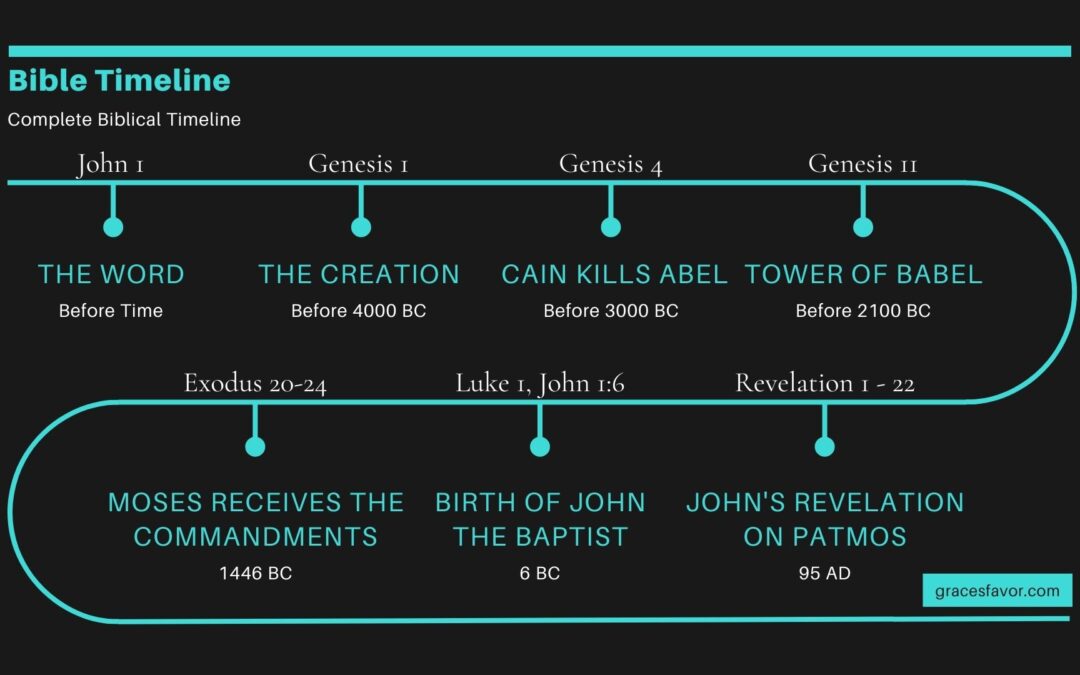
BC, BCE
1800 The timeline begins with the era of Abraham and the Patriarchs, setting the foundation for the history of the Israelites. Moving forward to 1290, the pivotal events of the Exodus, led by Moses and Joshua, shape the identity of the Israelite people. The establishment of the Israelite monarchy in 1050 marks a significant shift with the rise of figures like Samuel and Saul, leading to the reign of King David and the prophet Nathan in 1000 BC. The division of the Kingdom in 922 between Rehoboam and Jeroboam I sets the stage for a period of political and religious turmoil, culminating in the reign of Ahab and Jezebel, as well as the prophetic ministries of Elijah and Elisha in 850 BC. The rise of Assyria as a dominant world power in 745 BC brings about new challenges and opportunities, accompanied by the prophetic voices of Amos, Hosea, and Jeroboam II. The fall of Samaria in 721 BC marks the end of the Northern Kingdom, leading to a time of political upheaval under King Ahaz and the prophet Isaiah. The Assyrian invasion of Judah in 701 BC, and the subsequent deliverance from Sennacherib, highlight the crucial roles of King Hezekiah and the prophets Isaiah and Micah. The reforms initiated by King Josiah in 621 BC pave the way for a period of religious revival and cultural transformation. The Battle of Carchemish in 605 BC signals the rise of the Babylonian empire, accompanied by the prophetic voices of Jeremiah and Habakkuk. The first deportation of Israelites to Babylon in 598 BC marks a turning point in the history of the Israelites, setting the stage for the eventual destruction of Jerusalem and the second deportation in 586 BC, with the prophetic voices of Jeremiah and Ezekiel guiding the people through these tumultuous times. The overthrow of the Babylonian Empire by the Persians in 538 BC brings hope for the exiled Israelites, leading to the return from exile under the reign of Cyrus. The rebuilding of the Jerusalem temple in 520 BC, led by figures like Haggai, Zechariah, and Zerubbabel, marks a period of restoration and renewal for the Israelite community. The reforms of Ezra in 450 BC signify the beginning of Judaism as a distinct religious identity, alongside figures like Nehemiah and the prophet Malachi, whose teachings shape the faith of the Israelites. The death of Alexander the Great in 323 BC ushers in a new era of Greek control under the Seleucids and the Ptolomies, setting the stage for further political and cultural changes in the region. The Macabbean Revolt in 167 BC, led by Judas Macabbee and chronicled in the Book of Daniel, showcases the resilience and determination of the Jewish people against oppressive forces. The Roman control of Palestine under the general Pompey in 63 BC marks a shift in political power, leading to the rule of Herod the Great and the birth of Jesus in 6-4 BC. The timeline transitions to the dawn of the Common Era, with the death and resurrection of Jesus Christ in 27-30 AD, followed by the impactful ministry of Paul from 33 to 60 AD. The Council of Jerusalem in 45 AD signifies a pivotal moment in the divergence of Christianity from its Jewish roots, as reflected in the earliest New Testament writings such as 1-2 Thessalonians by Paul, Barnabus, and Silas in 50 AD. The writing of the first Gospel by Mark in 60-70 AD, accompanied by the death of Paul, signals a new chapter in the spread of the Christian faith. The destruction of Jerusalem by the Roman general Titus in 70 AD marks a tragic end to the Jewish rebellion against Roman rule, while the last New Testament writings including the Gospel of John and Johannine literature in 90 AD continue to shape the beliefs and practices of the early Christian community. The Bar Kochba rebellion in 135 AD represents the final Jewish revolt against Rome, leading to the expulsion of Jews from Palestine and the enduring legacy of resistance and resilience in the face of adversity.

Our Mission

Welcome we are dedicated to exploring the BIBLICAL Gospel after the cross, based on the KJV and Scripture. Our aim is to provide a comprehensive understanding of the New Testament, emphasizing the importance of right-standing with God.

We strive to include all relevant chapters and verses within our text, making it easier for you to research and understand the Scriptures. Our focus is on the transformative power of the Gospel and its implications for believers today.

Join us as we delve into the richness of the New Testament, offering insights and devotional content that brings the Word of God to life. Together, let’s grow in our faith and understanding of the Scriptures.

Key Figures and Their Actions

  • Jesus: Betrayal, Trial, Crucifixion
  • Peter: Heals and Preaches
  • Stephen: Speech, Stoning, and Death
  • Saul: Persecutes the Church
  • Paul: First Missionary Journey
  • Philip: Baptizes the Ethiopian Eunuch
  • Jesus: Resurrection
  • Peter: Preaches to the Gentiles
  • Paul: Writes to the Corinthians
  • John: Writes Revelation on Patmos
  • James: Writes His Letter
  • Timothy: Receives Letters from Paul
  • Barnabas: Sent to Antioch
  • Philip: Preaches in Samaria
  • Paul: Writes to the Romans
  • Peter: Led from Prison by an Angel
  • Paul: Writes to the Ephesians
  • John: Writes His First Letter

A JOURNEY THROUGH SACRED HISTORY

The Just Live By Faith
Romans 1:16
“For I am not ashamed of the gospel of Christ, for it is the power of God to salvation for everyone who believes, for the Jew first and also for the Greek.”

Greetings to the Saints in Rome

Paul, a servant of Jesus Christ, called to be an apostle, separated unto the gospel of God, (Which he had promised afore by his prophets in the holy scriptures,) Concerning his Son Jesus Christ our Lord, which was made of the seed of David according to the flesh; And declared to be the Son of God with power, according to the spirit of holiness, by the resurrection from the dead: By whom we have received grace and apostleship, for obedience to the faith among all nations, for his name: Among whom are ye also the called of Jesus Christ:

To all that be in Rome, beloved of God, called to be saints: Grace to you and peace from God our Father, and the Lord Jesus Christ.

Paul’s Desire to Visit Rome

(1 Thessalonians 2:17-20)
First, I thank my God through Jesus Christ for you all, that your faith is spoken of throughout the whole world. For God is my witness, whom I serve with my spirit in the gospel of his Son, that without ceasing I make mention of you always in my prayers; Making request, if by any means now at length I might have a prosperous journey by the will of God to come unto you. For I long to see you, that I may impart unto you some spiritual gift, to the end ye may be established; That is, that I may be comforted together with you by the mutual faith both of you and me. Now I would not have you ignorant, brethren, that oftentimes I purposed to come unto you, (but was let hitherto,) that I might have some fruit among you also, even as among other Gentiles. I am debtor both to the Greeks, and to the Barbarians; both to the wise, and to the unwise. So, as much as in me is, I am ready to preach the gospel to you that are at Rome also.

I am Not Ashamed of the Gospel

For I am not ashamed of the gospel of Christ: for it is the power of God unto salvation to every one that believeth; to the Jew first, and also to the Greek. For therein is the righteousness of God revealed from faith to faith: as it is written, The just shall live by faith.

God’s Wrath against Sin

(Jeremiah 6:10-21; Jeremiah 25:15-33; Jonah 1:4-10; Acts 27:13-26)

For the wrath of God is revealed from heaven against all ungodliness and unrighteousness of men, who hold the truth in unrighteousness; Because that which may be known of God is manifest in them; for God hath shewed it unto them. For the invisible things of him from the creation of the world are clearly seen, being understood by the things that are made, even his eternal power and Godhead; so that they are without excuse: Because that, when they knew God, they glorified him not as God, neither were thankful; but became vain in their imaginations, and their foolish heart was darkened. Professing themselves to be wise, they became fools, And changed the glory of the uncorruptible God into an image made like to corruptible man, and to birds, and fourfooted beasts, and creeping things.

Wherefore God also gave them up to uncleanness through the lusts of their own hearts, to dishonour their own bodies between themselves: Who changed the truth of God into a lie, and worshipped and served the creature more than the Creator, who is blessed for ever. Amen.

For this cause God gave them up unto vile affections: for even their women did change the natural use into that which is against nature: And likewise also the men, leaving the natural use of the woman, burned in their lust one toward another; men with men working that which is unseemly, and receiving in themselves that recompence of their error which was meet.

And even as they did not like to retain God in their knowledge, God gave them over to a reprobate mind, to do those things which are not convenient; Being filled with all unrighteousness, fornication, wickedness, covetousness, maliciousness; full of envy, murder, debate, deceit, malignity; whisperers, Backbiters, haters of God, despiteful, proud, boasters, inventors of evil things, disobedient to parents, Without understanding, covenantbreakers, without natural affection, implacable, unmerciful: Who knowing the judgment of God, that they which commit such things are worthy of death, not only do the same, but have pleasure in them that do them.

In the book of Genesis, we learn about the creation of the world, the fall of humanity in the story of Adam and Eve, the great flood with Noah, and the confusion of tongues at the Tower of Babel. Moving on to the story of Abraham, we see God making promises and the birth of Isaac, followed by the testing of Abraham and the narratives of Isaac and Rebekah, Jacob and Esau, as well as Jacob’s children. The focus then shifts to Joseph being sold by his brothers and his time in Egypt. In the book of Exodus, we witness the birth of Moses, the burning bush encounter, the ten plagues, Israel’s rescue from Egypt, and the giving of the Ten Commandments. The journey continues with the entry into the Promised Land under Joshua’s leadership, the period of judges ruling Israel, the anointing of Saul as the first king, and the reigns of David and Solomon. The narrative also touches on the division of Israel and Judah, the rule of various kings, and the warnings of prophets about God’s impending judgment. The accounts of Israel’s exile by Assyria and Judah’s exile by Babylon are also shared, followed by the return of many Israelites to rebuild the land and temple in Ezra. The wait for the “new covenant” promised by the prophets leads us through Isaiah to Malachi, setting the stage for the birth, baptism, temptations, teachings, miracles, and ultimate sacrifice and resurrection of Jesus as depicted in the Gospels. The spread of Christianity post-resurrection, the growth of the early church, and the revelations received by John on Patmos in the book of Revelation conclude this profound journey through biblical history.

THE PATH TO LIBERATION AND GRACE

Creation — Genesis 1: God creates the world in six days, forming light, sky, land, seas, vegetation, celestial bodies, animals, and finally humans, declaring creation good and resting on the seventh day.

The Fall (Adam and Eve) — Genesis 3: Adam and Eve disobey God by eating from the forbidden tree of knowledge, leading to their awareness of good and evil, their loss of innocence, and their expulsion from Eden.

Noah and the Flood — Genesis 6: God decides to flood the earth to cleanse it of human wickedness, instructing Noah to build an ark to save his family and pairs of every animal species.

The Tower of Babel — Genesis 11: Humanity, unified by a single language, builds a tower to reach the heavens. God confounds their language, causing them to scatter across the earth.

The Call of Abram — Genesis 12: God calls Abram (later Abraham) to leave his homeland and promises to make him a great nation, bless him, and make his name great.

God makes promises to Abraham — Genesis 15: God formalizes His covenant with Abraham, promising him numerous descendants and the land of Canaan.

The Birth of Isaac — Genesis 21: Isaac, the long-awaited son of Abraham and Sarah, is born, fulfilling God’s promise of an heir.

Abraham tested — Genesis 22: God tests Abraham’s faith by asking him to sacrifice Isaac. Abraham obeys, but an angel intervenes, providing a ram as a substitute offering.

Isaac and Rebekah — Genesis 24: Abraham’s servant finds Rebekah to be Isaac’s wife through a sign from God, ensuring the continuation of the covenantal lineage.

Jacob and Esau — Genesis 25: Jacob and Esau, twins born to Isaac and Rebekah, represent two nations. Jacob, the younger, secures Esau’s birthright and blessing through cunning means.

Jacob’s children — Genesis 29: Jacob marries Leah and Rachel, and through them and their maidservants, has twelve sons who become the heads of the twelve tribes of Israel.

Joseph sold by his brothers — Genesis 37: Joseph, Jacob’s favored son, is sold into slavery by his jealous brothers, who deceive Jacob into believing Joseph is dead.

Joseph in Egypt — Genesis 39: Joseph rises to prominence in Potiphar’s house but is imprisoned after being falsely accused by Potiphar’s wife. He interprets dreams in prison, gaining favor.

Israel in slavery in Egypt — Exodus 1: The Israelites multiply in Egypt, and a new Pharaoh, fearing their numbers, enslaves them and orders the death of all male Hebrew infants.

The birth of Moses — Exodus 2: Moses is born, hidden by his mother to escape Pharaoh’s decree, and is later discovered and adopted by Pharaoh’s daughter.

Moses and the Burning Bush — Exodus 3: God appears to Moses in a burning bush, commissioning him to lead the Israelites out of Egypt and revealing His name as “I AM.”

The Ten Plagues — Exodus 7: God inflicts ten plagues upon Egypt to convince Pharaoh to release the Israelites, including blood, frogs, lice, flies, disease, boils, hail, locusts, darkness, and the death of firstborns.

God rescues Israel from Egypt — Exodus 12: The Israelites celebrate the Passover and leave Egypt, with God parting the Red Sea for their escape and drowning the pursuing Egyptian army.

God gives the Ten Commandments — Exodus 20: On Mount Sinai, God gives Moses the Ten Commandments, outlining laws and ethical principles for the Israelites.

Israel enters the Promised Land (Joshua) — Joshua 1: Joshua succeeds Moses as leader and begins the conquest of Canaan, following God’s instructions to take possession of the Promised Land.

Israel ruled by judges (Gideon, Deborah, Samson, etc.) — Judges 1: Israel is governed by a series of judges who lead and deliver the people from oppression, with notable figures including Gideon, Deborah, and Samson.

Israel gets its first king (Saul) — 1 Samuel 9: Saul is anointed as Israel’s first king by the prophet Samuel, chosen to lead the people and deliver them from their enemies.

David is anointed king — 1 Samuel 16: God chooses David, a young shepherd, to be the next king of Israel, anointing him through Samuel while Saul is still king.

David and Goliath — 1 Samuel 17: David defeats the giant Goliath with a sling and a stone, demonstrating his faith in God and beginning his rise to prominence.

David becomes king — 2 Samuel 5: David is anointed king over all Israel, establishing Jerusalem as his capital and uniting the tribes of Israel under his rule.

Solomon becomes king — 1 Kings 1: Solomon, David’s son, is crowned king following David’s death, securing his reign and beginning a period of prosperity and wisdom.

Israel is divided: Israel and Judah — 1 Kings 12: After Solomon’s death, the kingdom divides into the northern kingdom of Israel and the southern kingdom of Judah, leading to political and religious fragmentation.


NEW AGE OF GRACE

Kings rule (mostly bad) for 345 years — 1 Kings 13 and following: Both Israel and Judah experience a succession of kings, most of whom lead the people away from God, resulting in moral and spiritual decline.

Prophets warn Israel of God’s coming punishment on the nation (while also promising a glorious future beyond judgment) — Chart of Israel’s and Judah’s Kings and Prophets: Various prophets, such as Isaiah and Jeremiah, forewarn of impending judgment due to the nation’s sins, yet also offer hope for future restoration and a new covenant.

Exile, part one: Israel (the northern half), conquered by Assyria — 2 Kings 17: The northern kingdom of Israel falls to Assyria, leading to the deportation of its people and the loss of its identity.

Exile, part two: Judah (the southern half), conquered by Babylon — 2 Kings 25: The southern kingdom of Judah is conquered by Babylon, resulting in the destruction of Jerusalem and the Temple, and the exile of its inhabitants.

Many Israelites return to Israel to rebuild the demolished land and temple — Ezra 1: After the Persian conquest of Babylon, King Cyrus allows the Israelites to return to Jerusalem and begin rebuilding the Temple.

The completion of the new temple — Ezra 6: The reconstruction of the Temple in Jerusalem is completed, marking a significant moment of restoration for the returning exiles.

Lots of waiting for the “new covenant,” which the prophets promised — Isaiah to Malachi: The period between the Old and New Testaments involves anticipation of the new covenant foretold by prophets, promising future redemption and renewal.

Jesus is born — Matthew 1 and Luke 2: Jesus Christ is born to Mary and Joseph in Bethlehem, marking the fulfillment of prophecies about the Messiah’s coming.

Baptism of Jesus — Matthew 3; Mark 1; and Luke 3: Jesus is baptized by John the Baptist in the Jordan River, signifying the beginning of His public ministry and receiving divine affirmation.

Temptation of Jesus — Matthew 4; Mark 1; and Luke 4: Jesus is tempted by Satan in the desert but resists, demonstrating His obedience and preparation for His mission.

Sermon on the Mount — Matthew 5: Jesus delivers the Sermon on the Mount, offering teachings on ethics, spirituality, and the nature of God’s kingdom, including the Beatitudes.

The Transfiguration — Matthew 17; Mark 9; and Luke 9: Jesus is transfigured on a mountain, revealing His divine glory to Peter, James, and John, and conversing with Moses and Elijah.

Jesus Affirms he is the Son of God — John 9: Jesus heals a man born blind and asserts His divine identity as the Son of God, challenging the religious authorities.

The Triumphal Entry — Matthew 21; Mark 11; Luke 19; and John 12: Jesus enters Jerusalem on a donkey, greeted by crowds with palm branches, symbolizing His kingship and the fulfillment of prophecy.

The Last Supper — Matthew 26; Mark 14; Luke 22; and John 13: Jesus shares the Passover meal with His disciples, instituting the Lord’s Supper (Eucharist) and predicting His impending betrayal and death.

Jesus’ Betrayal, Trial, Crucifixion — Matthew 27; Mark 15; Luke 23; and John 18: Jesus is betrayed by Judas, tried before religious and Roman authorities, and crucified, fulfilling His mission of atonement for sin.

Jesus’ Resurrection — Matthew 28; Mark 16; Luke 24; and John 20: Jesus rises from the dead on the third day after His crucifixion, demonstrating victory over sin and death, and appearing to His disciples.

The Ascension — Acts 1: Jesus ascends to heaven in the presence of His disciples, promising them the coming of the Holy Spirit and instructing them to be His witnesses to the ends of the earth.

The Holy Spirit Comes at Pentecost — Acts 2: The Holy Spirit descends upon the apostles at Pentecost, enabling them to speak in various languages and marking the beginning of the Christian church.

The church’s first martyr — Acts 6: Stephen, one of the seven deacons chosen to serve the church, is arrested and becomes the first Christian martyr when he is stoned to death for his faith.

Saul’s Conversion — Acts 9: Saul of Tarsus, a persecutor of Christians, has a dramatic encounter with Jesus on the road to Damascus and is converted, later becoming known as Paul, a key apostle.

The growth of the church — The book of Acts: The early Christian church expands rapidly through the apostles’ preaching, missionary journeys, and the work of early believers, despite facing persecution and challenges.

John’s Revelation on Patmos — The book of Revelation: The Apostle John receives a series of visions while exiled on the island of Patmos, revealing symbolic messages about the end times, the final victory of Christ, and the promise of a new heaven and new earth.

SHARE THE GIFT OF GRACE

Deepen Your Understanding

Discover the profound truths of the BIBLICAL Gospel and understand the essence of right-standing in GOD. Dive into the chapters and verses listed on our website for a comprehensive study and enrich your spiritual journey. Engage with the scriptures and let the Holy Spirit guide you in your devotion.

EMBRACED BY GRACE LIVING IN HIS RIGHTEOUSNESS

UNDERSTANDINGS OF GOD'S RIGHTEOUSNESS

“God made him who had no sin to be sin for us, so that in him we might become the righteousness of God” (2 Corinthians 5:21).

One of the profound benefits of salvation is that you are endowed with the righteousness of God.

This concept may seem lofty at first glance, but as we explore its depths, we discover just how significant it truly is.

So, I pose this question: do you genuinely grasp the full meaning of righteousness, particularly the righteousness that belongs to God? To shed light on this topic, I want to elucidate three essential aspects of God’s righteousness.

At its core, the righteousness of God signifies His absolute justice, holiness, and fairness in every action and decision He makes. This characteristic lies at the heart of who He is, a truth that resonates throughout the scriptures. For instance, in Psalm 145:17, we read that the Lord is righteous in all his ways and faithful in all he does, emphasizing that God’s actions are inherently right and just, showcasing His unwavering dedication to moral perfection and equity.

Furthermore, biblical commentary underscores that God’s righteousness transcends mere theory; it is actively demonstrated in His interactions with humanity. Moses captures this truth in Deuteronomy 32:4, affirming that God is the Rock, whose works are flawless, and whose ways are entirely just. This passage reveals that God’s righteousness is not just an abstract idea but is evident in His perfect deeds and just judgments.

Additionally, we see God’s righteousness vividly portrayed in His response to human sin and His generous provision of salvation. Romans 3:25-26 highlights how God presented Christ as a sacrifice of atonement through His blood, to be received through faith, thereby illustrating His righteousness by addressing the sins committed before while ensuring justice and also justifying those who believe in Jesus. In the context of 2 Corinthians 5:21, righteousness is understood as receiving God’s approval, meaning that when God looks upon you, He sees you as a bearer of His righteousness and considers you justified in His sight. Reflecting on this profound truth can lead to an overwhelming sense of joy because it reveals that God sees you and approves of you, prompting the urge to express your gratitude with a shout of praise, or at the very least, some heartfelt acknowledgment of His goodness. Understanding the definition of God’s righteousness is indeed marvelous, yet it calls for a deeper exploration. Therefore, I would like to share with you three key insights about the righteousness of God.

1. God’s righteousness is not something we achieve through our own efforts; rather, it is a gift bestowed upon us through a divine exchange.
God’s righteousness and the way He views you as approved is truly remarkable because no amount of effort on your part can ever earn His approval, and this reality is not just extraordinary but also profoundly liberating. It frees you from the relentless pursuit of perfection and the constant anxiety of measuring up. Picture the exhausting strain of navigating life filled with doubt about whether you have done enough to gain God’s favor. This heavy burden is simply too much to bear and ultimately distracts you from experiencing the grace and love that God readily offers. I genuinely want you to let go of that pressure and embrace the peace that comes from knowing that you are already accepted.

To fully grasp the depth of God’s righteousness, one must understand that it is a divine gift freely bestowed upon us rather than something we can earn through our own efforts. This remarkable exchange unfolds in a profound way: Christ, in his immense love, took upon himself the weight of our sins, embodying them fully and completely, and in return, he offers us his own righteousness, pure and unblemished. To be seen as righteous in the eyes of God, it is essential to wholeheartedly place all of your sins onto Christ, embracing the incredible gift of his righteousness. Although this may seem difficult to comprehend at times, as it feels almost too wondrous to believe, I assure you it is indeed true. If you open your heart and permit God to work in your life, he will graciously take your sins and exchange them for his perfect righteousness, which, my friend, is an opportunity beyond measure.

2. The righteousness of God cannot be bought or earned, it is paid for
The incredible truth about God’s righteousness is that it comes to you entirely free of charge, yet it exacted an unimaginable cost from Jesus. The reality is that the value of your righteousness is so immense that no amount of wealth could ever secure it for you. This is indeed uplifting news because God does not require you to pay for something that is beyond your reach. Instead, the price has already been fully covered, allowing you to receive this precious gift without the burden of payment.

“So, now that we have been made righteous by his blood, we can be even more certain that we will be saved from God’s wrath through him” (Romans 5:9).

Through the sacrifice of Jesus Christ, you are made righteous and justified, as the timeless hymn expresses.

“There is a fountain filled with blood drawn from Emmanuel’s veins. And sinners plunged beneath that flood lose all their guilty stains.”

You and I were guilty as sin, completely deserving of the consequences of our actions and separated from the purity of God. Yet there was a savior, Jesus Christ, who willingly descended from the glory of heaven, offering Himself as a sacrifice and shedding His precious blood so that all our filthy, sinful stains would be washed away, cleansing us completely and allowing us to be declared righteous in the eyes of God. If you have truly received Jesus Christ as your Lord and Savior, then in this very moment, right now, you stand righteous before God, free from all guilt and shame. The weight of all our wrongdoings has been lifted, paid in full by the blood of Jesus, which has been graciously applied to your account, ensuring that your sins are no longer held against you. There is nothing more required for your redemption and acceptance in God’s family, for His love and grace have transformed your standing forever.

3. The righteousness of God transcends the fleeting moments of time and stands forever.
It’s important to recognize that many Christians face challenges with sin, repentance, forgiveness, and understanding God’s righteousness. However, it’s crucial to grasp that when God declares you righteous, that declaration is not fleeting; it is everlasting. In a courtroom, if a case is dismissed with prejudice, it signifies a permanent closure—it cannot be reopened. Similarly, when God pronounces you righteous, He is effectively dismissing your original sin case once and for all, sealing it so that it can never be brought up again. Reflect on the wisdom found in the book of Romans.

“But now apart from the law the righteousness of God has been made known, to which the Law and the Prophets testify. This righteousness is given through faith in Jesus Christ to all who believe. There is no difference between Jew and Gentile, for all have sinned and fall short of the glory of God, and all are justified freely by his grace through the redemption that came by Christ Jesus” (Romans 3:21-24).

Through God’s justification or declaration of righteousness over your life, you have been made right in his sight, a profound truth that carries significance both in the present and for all eternity. This understanding of God’s righteousness is foundational, as it assures you that the issue of original sin has been fully addressed, granting you not only the status of being the righteousness of God but also elevating you to the realm of his cherished possession. This means that you are valued and loved, belonging to him not just temporarily but for an everlasting relationship that transcends time and circumstance.

“But you are a chosen people, a royal priesthood, a holy nation, God’s special possession, that you may declare the praises of him who called you out of darkness into his wonderful light. Once you were not a people, but now you are the people of God; once you had not received mercy, but now you have received mercy” (1 Peter 2:9-10).

How Does God’s Righteousness Apply When I Sin?
Understanding the significance of sin in the context of God’s declaration of righteousness is crucial. As previously highlighted, one key aspect of God’s righteousness is its direct engagement with your original sin. This is the very sin that created a barrier between you and God, the one that could have led to eternal separation from Him. However, this sin has been confronted, resolved, and ultimately dismissed with prejudice. That’s how Paul could righteously write in Romans 8:1 “Therefore, there is now no condemnation for those who are in Christ Jesus.”

He penned these profound words immediately following a discussion about the universal struggle we encounter with our sinful nature, shedding light on the inner battles that each of us faces in our daily lives. in Romans 7. He expressed it this way

“For I know that good itself does not dwell in me, that is, in my sinful nature. For I have the desire to do what is good, but I cannot carry it out. For I do not do the good I want to do, but the evil I do not want to do — this I keep on doing” (Romans 7:18-19).

You can see the internal battle that Paul recognizes the body of Christ(church) is facing, and I resonate with that struggle deeply. He openly recognizes that while we are in this physical body, we will inevitably encounter difficulties stemming from our sinful nature. However, it is essential to understand that these ongoing struggles do not undermine your position of righteousness before God. In truth, the word condemnation carries with it the notion of a penalty imposed after a trial has taken place. Yet, because you embody the righteousness of God, you have already faced that trial and emerged with a verdict of not guilty; thus, there is no eternal penalty that awaits you. Embrace this truth with confidence as it assures you of your rightful standing with God, regardless of your battles.

Does this mean I have permission to sin?
It does not. I believe that someone who interprets God’s grace or His pronouncement of righteousness as permission to sin lacks a true grasp of justification and grace. One must question whether they have genuinely accepted Christ in their life. Although sin does not alter your status of righteousness, it does hinder your capacity to maintain a close relationship with God. This is why it is important to repent swiftly when you sin, as it helps to preserve the connection between you and God.

It is important to recognize that while sin may not sever your declaration of faith or lead to condemnation, it can still result in significant consequences in your earthly life. These consequences stem from the choices you make and can affect various aspects of your existence. However, it is crucial to remember that the repercussions you experience are temporary rather than eternal, as your ultimate salvation has already been secured through Christ’s sacrifice. Therefore, relying on the guidance and strength of the Holy Spirit, strive diligently to steer clear of sin in all circumstances. Yet, if you stumble and find yourself ensnared by sin, do not hesitate to repent swiftly and sincerely. This act of repentance is vital for preserving the precious and beautiful fellowship you have with the Father, enabling you to return to a place of grace and intimacy in your relationship with Him.

To explore the concept of righteousness, it’s essential to recognize that it’s a profound aspect of God’s nature. Rather than viewing righteousness as a goal to attain or a state to achieve over time, understand that it is an integral part of your identity once you are embraced by God’s grace. When you are declared right with God and receive His approval, you inherently possess that righteousness, meaning that you do not need to strive to become more righteous; instead, you are already complete in that standing before Him.

In contemplating this question, I would frame it like this: how can I embody the character of Christ more fully? As a believer, your aspiration should be to emulate Christ in your thoughts, actions, and overall demeanor. By doing so, you become a reflection of His essence in the world. This is ultimately what God wishes for us in our lives.

Instead of striving to be more righteous, recognize that you already possess this quality through your faith; the focus should be on becoming more like Christ in your daily life. Embrace the journey of transformation, knowing that the Holy Spirit is present to guide and support you every step of the way. Invite His presence into your heart by praying for the Holy Spirit to come, and watch as He empowers you to reflect the love and grace of Christ in all that you do.

“I will give you a new heart and put a new spirit in you; I will remove from you your heart of stone and give you a heart of flesh. And I will put my Spirit in you and move you to follow my decrees and be careful to keep my laws” (Ezekiel 36:26-27).

A Closing Thought; As we conclude this journey together, it’s important to reflect on the insights we’ve gained and the connections we’ve formed. Each ending paves the way for new beginnings, offering us the opportunity to learn from our experiences and grow in ways we might not have anticipated. Embracing these moments allows us to carry forward the wisdom gained, shaping a brighter path ahead that is filled with potential and purpose. Remember that every ending is merely a stepping stone toward future possibilities, inviting us to remain curious and open to what lies beyond.
Today my friends, you are declared righteous. Now I challenge you to do one thing. Live like it. With the help of the Holy Spirit live like one who has been tried and found not guilty, because that is what you are.

Understanding the righteousness of God can be complex, but perhaps one of the most vital truths is realizing that you are cherished in His eyes. Embrace today with the assurance that if you have accepted Christ, you are both gifted with and embody the righteousness of God. You are free from doubt and can rest in this certainty forever.

Feelings Follow Actions

Feelings Follow Actions

Understanding the Parable of the Sower

Insights into Jesus' Teachings

Explore the profound lessons from one of Jesus’ most well-known parables, as found in the Gospels of Matthew, Mark, and Luke. Discover how different types of soil represent the varied responses to the Word of God.

We want to have a teachable heart where God’s truth can produce good fruit.

As we share the truth of Jesus with others, we can see ourselves as the “sower” in this story. Just like in the parable, some will receive the message with open hearts, allowing it to take root and bear fruit, while others may resist or be indifferent. Remember, it is not our job to force growth but to faithfully sow the seed of truth. We are called to share the message and trust God to work in the hearts of those we speak to. Pray for God to soften the hearts of those who hear the message, knowing that ultimately, it is up to each individual to choose whether to accept the truth.(2 Peter 3:9), (1 Corinthians 12:3), (Acts 22:14-15)

A new heart also will I give you, and a new spirit will I put within you: and I will take away the stony heart out of your flesh, and I will give you an heart of flesh. (Ezekiel 36:26)

Pray

God, I love you; In Jesus name I pray that you would make me holy as you are holy. God, help me to hate sin more today than I did yesterday. Help me not to be casual with sin in any way. (Ezekiel 36:26)
Amen

Ezekiel is often depicted as a man who was overtaken by the Spirit of the Lord. The rûaḥ seizing the prophet, entering him (Ezek 2:2), or falling upon him (Ezek 3:24), signifies the divine power of God working within him, guiding him to speak the words revealed to him (Ezek 11:5) and empowering him to faithfully carry out his divine mission.

In the book of Ezekiel, we witness the profound encounters between the prophet and the Spirit of the Lord. These divine interactions empower Ezekiel to faithfully carry out his mission, inspiring him with unwavering faith and commitment. Through these experiences, he delivers messages and obediently follows God’s guidance, demonstrating the remarkable power at work within him.

Every action, big or small, good or evil, is a seed. All spiritual seeds will bear fruit whether the sower anticipates it or not.

The Parable of the Sower

In the Parable of the Sower, Jesus uses the imagery of a sower scattering seeds to illustrate how people receive and respond to the Word of God. This parable is recounted in Matthew 13:1-23, Mark 4:1-20, and Luke 8:1-15.

The seeds fall on different types of soil, each representing a different type of hearer. The path, rocky ground, thorns, and good soil each symbolize how individuals understand and act upon God’s message. This parable emphasizes the importance of a receptive heart to cultivate a fruitful spiritual life.

Types of Soil in the Parable

The Path
Hearers Who Do Not Understand
Seeds that fall on the path

Scripture: Matthew 13:4 (KJV) – “And when he sowed, some seeds fell by the way side, and the fowls came and devoured them up.”

Explanation: Seeds that fall on the path are quickly eaten by birds, symbolizing those who hear the Word but do not understand it, allowing the evil one to snatch it away.

Rocky Ground
Hearers Who Fall Away
Seeds that fall on rocky ground

Scripture: Matthew 13:5-6 (KJV) – “Some fell upon stony places, where they had not much earth: and forthwith they sprung up, because they had no deepness of earth: And when the sun was up, they were scorched; and because they had no root, they withered away.”

Explanation: Seeds that fall on rocky ground sprout quickly but wither due to lack of root, representing those who receive the Word with joy but fall away when troubles arise.

Among Thorns
Hearers Distracted by Worries
Seeds that fall among thorns

Scripture: Matthew 13:7 (KJV) – “And some fell among thorns; and the thorns sprang up, and choked them.”

Explanation: Seeds that fall among thorns are choked by them, symbolizing those who hear the Word but are distracted by life’s worries and the deceitfulness of wealth, making it unfruitful.

Good Soil
Hearers Obeying Listening
Some seeds fall on good soil

Scripture: Matthew 13:8 (KJV) – “But other fell into good ground, and brought forth fruit, some an hundredfold, some sixtyfold, some thirtyfold.”

Explanation: Some seeds fall on good soil and produce a crop, yielding a hundred, sixty, or thirty times what was sown. This represents people who hear the Word, understand it, and produce a fruitful harvest.

CULTIVATING HEARTS FOR HIS WORD

NURTURING THE SEEDS OF FAITH

Cultivating good soil for God’s Word involves preparing our hearts and minds to receive and nurture His teachings. Here are some practical steps to help you cultivate good soil:

1. Prayer: Regularly communicate with God through prayer. Ask Him to open your heart and mind to His Word and to help you understand and apply it in your life.

2. Study the Bible: Spend time reading and studying the Bible. Reflect on its teachings and seek to understand its deeper meanings. Consider joining a Bible study group for additional insights and support.

3. Obedience: Apply God’s Word in your daily life. Strive to live according to His teachings and commandments. Obedience to God’s Word helps it take root and grow in your heart.

4. Repentance: Regularly examine your life and repent of any sins. Confession and repentance help remove the “weeds” that can choke out God’s Word.

5. Fellowship: Surround yourself with other believers who can encourage and support you in your faith journey. Attend church services, participate in small groups, and build relationships with fellow Christians.

6. Meditation: Take time to meditate on God’s Word. Reflect on its meaning and how it applies to your life. Meditation helps deepen your understanding and connection to God’s teachings.

Service: Serve others in love and humility. Acts of service and kindness reflect God’s love and help you grow spiritually.

8. Guard Your Heart: Be mindful of what you allow into your heart and mind. Avoid negative influences and focus on things that are true, noble, right, pure, lovely, and admirable (Philippians 4:8).

By taking these steps, you can create a fertile environment for God’s Word to grow and bear fruit in your life.

Understanding the Parable

The Heart of the Parable of the Sower

The Parable of the Sower, as recounted in Matthew 13:1-23, Mark 4:1-20, and Luke 8:1-15, teaches us about the different ways people receive and respond to the message of the Kingdom of God.

Jesus uses the imagery of a sower scattering seeds on various types of soil to illustrate the conditions of human hearts.

The primary lesson is that a receptive and understanding heart is crucial for the Word of God to take root and bear fruit. Without such a heart, the message can be easily snatched away, wither under pressure, or be choked by life’s distractions.

To truly benefit from God’s Word, we must cultivate a heart that is like good soil—ready to receive, understand, and nurture the divine message. This parable emphasizes the importance of being open and prepared to let God’s teachings grow within us, leading to a fruitful and spiritually enriched life.

Jesus explained the parable of the sower by saying, “The seed is the word of God” (Luke 8:11). Plant that seed deep in your heart, your spirit, your mind, and your body. Let it take root and grow in your life, for it brings life, health, and everything you need. That’s because God is in His Word

The seed is the word of God.

Four Types Of Faith

The parable of the farmer sowing seeds in chapter 8 of Luke, while one of the more well-known parables, is also a powerful call to self-reflection, inviting us to examine the state of our own hearts and the receptiveness to divine truths. This story illustrates how different environments affect the growth of the seeds, metaphorically encouraging us to consider the conditions of our lives and how they influence our spiritual journeys. By pondering the lessons of this parable, we can gain insight into our own responses to the teachings we encounter, recognizing that our willingness to embrace growth can lead to a more fruitful existence.

While the parable itself is important, it is the explanation that Christ provides to His apostles that stands out as particularly extraordinary, as it reveals profound truths about faith, morality, and the nature of God’s kingdom, offering insights that illuminate the deeper meanings behind His teachings and guide the disciples in their understanding of His mission and the responsibilities that lay ahead of them.

The meaning of the parable unfolds as follows: the seed symbolizes the word of God. Those who are positioned along the path represent individuals who listen but are quickly influenced by the devil, who snatches the word away from their hearts, preventing them from believing and ultimately being saved. Meanwhile, those who find themselves on rocky ground initially receive the word with great joy upon hearing it; however, they lack a strong foundation. Although they believe temporarily, when faced with challenges and trials, their faith wavers, and they fall away. The seed that lands among thorns signifies people who also hear the word, but as they continue on their journey, they become overwhelmed by the worries of life, the allure of riches, and the pursuit of pleasure, hindering their spiritual growth. In contrast, the seed that is sown in good soil represents those with a noble and good heart. These individuals hear the word, hold on to it firmly, and through their perseverance, they yield a fruitful harvest, demonstrating the transformative power of their faith. (Luke 8:11-15)

As we delve deeper into the four distinct types of faith illustrated by Christ in this profound parable, we are invited to reflect honestly on the role that God’s word plays in our lives and the choices we make in response to it, prompting us to evaluate our spiritual journey and the strength of our commitment to His teachings:

Apathetic Faith

This belief never established itself – it didn’t even penetrate the ground. It was crushed underfoot due to its fragility and devoured for lack of roots to anchor it. This faith lacks vigor, with its essence flickering like a candle in the wind. It persists merely in existence, a shadow of what it could be, yet remains dormant on the periphery, overshadowed by stronger convictions and left to languish in obscurity without the nourishment it desperately needs to thrive.

This kind of faith or absence of it is deeply woven into the fabric of contemporary society. It flourishes in the belief that if I lead a good life, do my best, and avoid causing harm to others, then I am alright. I consider myself a good person after all. Christianity offers valuable teachings and moral guidance, so as long as I strive to embody some of those principles, I find comfort in the knowledge that I am on the right path, as I embrace the profound truth that God loves me unconditionally. This divine love reassures me that, regardless of the choices I make or the challenges I face, I can trust that everything is unfolding as it should. With this understanding, I feel a sense of peace and confidence that allows me to navigate life’s journey with hope and resilience, knowing that I am held in grace.

Selfish Faith

In its fervent quest for survival, this tender seed pushes forth with unwavering determination, reaching ever higher in its pursuit of warmth and light, driven by an instinctual yearning to thrive amidst adversity. Each moment is a frantic race against time as it diligently gathers precious droplets of water, its sole sustenance, to fortify its fragile structure. But in its relentless ambition to touch the sky and claim a life of abundance, this seed, blinded by its desires, stretches beyond the limits of its delicate roots, unable to find the solid ground it needs. The very breeze that once offered gentle encouragement soon becomes a harbinger of its downfall, and in the face of overwhelming odds, it succumbs to the reality of its own aspirations, wilting sadly in the shadow of the dreams it so ardently pursued.

This is selfish faith, thriving in the belief that if I just pray enough if I serve enough and if I do enough good works then God will bless me and I will enjoy a life that is both fulfilling and prosperous. This understanding of faith ultimately misses the true essence of what faith should be, as its foundation is fundamentally flawed. It is centered around me, focusing on personal gain and reward rather than being centered on Christ and His teachings. While it may appear promising at first, as it expresses itself through heartfelt prayers and acts of kindness, it ultimately fails to recognize that genuine faith is not about what we can achieve for ourselves but about a deeper relationship with Christ that transforms our hearts and perspectives.

Material Faith

As the buds begin to form, they herald the promise of breathtaking blossoms, captivating in their potential. This seed, utterly entranced by its own beauty, dances gracefully in the gentle breeze, yet ultimately becomes ensnared in the unforgiving thorns that encircle it. Brimming with pride, it stubbornly overlooks the painful jabs of each thorn, refusing to acknowledge the growing constraints around it, until the weight of its surroundings suffocates its very essence. This is the essence of material faith.

As individuals who adhere to this faith reflect on their lives, they may indeed recognize the abundant blessings and the unmistakable presence of God surrounding them, yet it often occurs that their focus gradually shifts away from Him. Rather than offering their adoration to the divine creator who bestows these gifts, they may find themselves captivated by the allure of the created world. In this shift, instead of drawing joy and fulfillment from a deep and abiding love for Christ, they may turn to the fleeting satisfaction that material possessions can provide. This transformation reveals a concerning truth about the essence of such faith, which can become preoccupied with the pursuit of worldly treasures, placing greater value on external adornments than on fortifying the spirit with the true armor of God that sustains and empowers one’s faith journey.

Devoted Faith

A faith where the seed fell on good soil, to grow and be nourished and yield abundant crop. Beautifully it buds, each year more brilliantly than the last, continually stronger and unshaken by the storms. Standing tall, it knows its worth and lives to share that worth and beauty. This faith, rooted deep in rich earth, embraces every opportunity to flourish, its branches reaching out to touch the world, offering shelter and sustenance. As it sways gently in the breeze, it becomes a beacon of hope and resilience, inspiring all who encounter its vibrant presence. The fruits it bears are a testament to the nurturing care it receives, and each bloom is a celebration of the life it nurtures within and around it.

This is unwavering faith, a steadfast belief that is built to endure and carefully nurtured to thrive through the most daunting challenges life may present. This is a faith anchored in Christ, a belief that proclaims, I am nothing without my Savior and to Him I owe everything. With Him as my foundation, I find strength in my moments of weakness, and it is through Him alone that I discover true fulfillment and purpose in my life.

NURTURING A DEEPER FAITH JOURNEY

NURTURING A PATH OF FAITH AND UNDERSTANDING

These descriptions of four types of faith encourage us to engage in a more profound and thoughtful examination of the essence and foundations of our own beliefs, prompting us to consider how these varied expressions of faith resonate with our individual spiritual journeys and understanding.

Are we truly driven by a heartfelt desire to seek God, or are we instead grappling with distractions and pressures that are stifling our aspirations and redirecting our intentions toward lesser pursuits?

No matter the paths we have wandered or the passions that have captured our hearts, we find solace in the truth that it is never too late to nurture our faith, redirecting our energies to embrace God as the central guiding light of our lives.

If we genuinely open our hearts to God’s Word, we will undoubtedly hear it resonate within us, empowering us to bear abundant fruit that glorifies Him. As Christ illustrated at the conclusion of the parable, this divine communication transforms our understanding and inspires our actions, enabling us to reflect His love and mission in our lives. By embracing His teachings and allowing them to guide our daily choices, we become vessels of His grace, contributing positively to the world around us and fulfilling our purpose as His children.  “Whoever has ears to hear, let them hear.” — Luke 8:15

Cultivating the Heart: How Feelings Follow Actions in Light of the Parable of the Sower and the Gardener

The Foundation: Feelings and Actions

The principle that “feelings follow actions” is a profound truth in both spiritual and practical realms. Often, our emotions can be influenced by our actions, just as our actions can be guided by our feelings. This interplay is crucial when considering how to nurture and grow our faith and character.

Biblical Insights on Confidence and Overcoming Obstacles

1. Lost Confidence and Offense
– 1 John 4:17 (KJV): “Herein is our love made perfect, that we may have boldness in the day of judgment: because as he is, so are we in this world.” This verse reminds us of the confidence we should have in our standing before God, which can be shaken by offenses or challenges.
– Mark 4:16-17 (KJV): “And these are they likewise which are sown on stony ground; who, when they have heard the word, immediately receive it with gladness; And have no root in themselves, and so endure but for a time: afterward, when affliction or persecution ariseth for the word’s sake, immediately they are offended.”
– Acts 19:13-16 (KJV): This passage recounts the story of the seven sons of Sceva, who tried to invoke the name of Jesus without true faith and were overcome by evil spirits, showing the importance of genuine relationship with God.

2. Strength and Courage
– Joshua 1:9 (KJV): “Have not I commanded thee? Be strong and of a good courage; be not afraid, neither be thou dismayed: for the Lord thy God is with thee whithersoever thou goest.” This command to Joshua emphasizes acting with courage and strength, trusting that God is with us.

The Parable of the Sower: A Gardening Analogy

The Parable of the Sower, found in Mark 4:14-20 (KJV), offers a powerful metaphor for spiritual growth:

– Mark 4:14 (KJV): “The sower soweth the word.”
– Mark 4:15-20 (KJV): This passage explains how the word is received differently by various types of soil, representing different conditions of the heart.

In modern organic gardening, similar principles apply:

1.Preparation of Soil
– Mark 4:8 (KJV): “And other fell into good ground, and brought forth fruit, some an hundredfold, some sixtyfold, some thirtyfold.” Good soil requires preparation—removing weeds and rocks, and enriching it with nutrients, similar to how our hearts must be prepared to receive the Word.

2. Nurturing Growth
– 1 Peter 1:23 (KJV): “Being born again, not of corruptible seed, but of incorruptible, by the word of God, which liveth and abideth forever.” Just as plants need water and sunlight to grow, our spiritual lives require consistent nourishment from the Word of God.

Applying the Principles: Spiritual and Practical Growth

1. Consistency in Actions
– Romans 10:17 (KJV): “So then faith cometh by hearing, and hearing by the word of God.” Consistent actions of studying and applying Scripture will lead to increased faith and transformation.
– Joshua 1:8 (KJV): “This book of the law shall not depart out of thy mouth; but thou shalt meditate therein day and night, that thou mayest observe to do according to all that is written therein: for then thou shalt make thy way prosperous, and then thou shalt have good success.”

2. Transformation Through the Word
– 2 Timothy 2:1-2 (KJV): “Thou therefore, my son, be strong in the grace that is in Christ Jesus. And the things that thou hast heard of me among many witnesses, the same commit thou to faithful men, who shall be able to teach others also.” Passing on what we learn and applying it in our lives ensures growth and stability in our faith.

– 1 Peter 1:21 (KJV): “Who by him do believe in God, that raised him up from the dead, and gave him glory; that your faith and hope might be in God.” Our faith and hope are strengthened through understanding and applying God’s Word.

3. Living by the Spirit
– Galatians 5:16 (KJV): “This I say then, Walk in the Spirit, and ye shall not fulfill the lust of the flesh.” Living according to the Spirit helps us to act in alignment with God’s will, leading to spiritual fruitfulness.

– Colossians 3:17 (KJV): “And whatsoever ye do in word or deed, do all in the name of the Lord Jesus, giving thanks to God and the Father by him.”

Conclusion: Cultivating a Fruitful Life

Combining these principles—acting with courage, preparing the soil of our hearts, nurturing our spiritual growth, and consistently applying the Word—leads to a fruitful and confident Christian life. By embracing the parable of the sower and the insights from modern gardening techniques, we can better understand how to cultivate our hearts and minds, allowing God’s Word to bear abundant fruit in our lives.

1 John 5:7-8 (KJV): “For there are three that bear record in heaven, the Father, the Word, and the Holy Ghost: and these three are one. And there are three that bear witness in earth, the Spirit, and the water, and the blood: and these three agree in one.”

John 17:17 (KJV): “Sanctify them through thy truth: thy word is truth.”

Through diligent preparation, consistent action, and nurturing, we align ourselves with God’s will, leading to a harvest of righteousness and spiritual vitality.

Cultivating Good Soil

Practical Steps to Prepare Your Heart for God's Word

Overcoming distractions and worries that can choke out God’s Word requires intentional effort and reliance on God’s strength. Here are some practical steps to help you stay focused and grounded:

1. Prioritize Time with God: Set aside dedicated time each day for prayer, Bible study, and meditation. Make this time a priority, and treat it as an essential part of your daily routine.

2. Cast Your Cares on God: Bring your worries and concerns to God in prayer. Trust that He cares for you and is able to handle your burdens (1 Peter 5:7).

3. Limit Distractions: Identify and minimize sources of distraction in your life. This may include reducing screen time, setting boundaries with social media, and creating a quiet space for prayer and study.

4. Practice Mindfulness: Stay present and focused during your time with God. If your mind starts to wander, gently bring it back to the task at hand. Mindfulness can help you stay engaged and attentive.

5. Memorize Scripture: Commit key Bible verses to memory. Having God’s Word stored in your heart can help you stay grounded and focused, even in the midst of distractions and worries.

6. Seek Accountability: Share your goals and struggles with a trusted friend or mentor. They can provide encouragement, support, and accountability as you work to overcome distractions.

7. Simplify Your Life: Evaluate your commitments and responsibilities. Simplifying your schedule and reducing unnecessary activities can help you create more space for spiritual growth.

8. Focus on God’s Promises: Remind yourself of God’s promises and faithfulness. Meditate on verses that speak to His provision, peace, and presence in your life.

9. Practice Gratitude: Cultivate an attitude of gratitude by regularly thanking God for His blessings. Focusing on the positive aspects of your life can help shift your perspective away from worries and distractions.

10. Stay Connected to a Faith Community: Engage with a community of believers who can support and encourage you. Regular fellowship and worship can help you stay focused on God’s Word.

By implementing these strategies, you can create an environment that allows God’s Word to take root and flourish in your life. If you have any more questions or need further guidance, feel free to ask or to join us in discipleship!

Take Action Today

Now that you understand the importance of having a receptive heart and the practical steps to cultivate good soil for God’s Word, it’s time to take action. Begin incorporating these practices into your daily life and watch as God’s Word takes root and bears fruit in your heart. Join us in this spiritual journey and experience the transformative power of living according to His teachings.

Luke 8:15 says, “but the seed in the good soil, these are the ones who have heard the word in an honest and good heart, and hold it fast, and bear fruit with perseverance.”

We can also see ourselves as the sower in this story. As you begin to share the truth of Jesus with others, you will see these four different reactions. Some people will be good soil. They will accept the truth, it will grow deep roots, and they will bear much fruit. But, sadly, others will be like the problem soils. God wants everyone to follow Him, but each person has the free choice of whether to accept the truth. Remember that you are not responsible to make the seed grow! You are just asked to spread the seed. It’s always right to pray for God to soften the hearts of those you speak to. God knows your heart now, He wants you with him.

Pray

Father, Thank you so much for everything, especially the peace and love in Spirit, In Jesus’ name we ask., help us by the grace and power of Your Spirit to imitate Your Son, our Lord Jesus, in His deep appreciation for the importance of nurturing relationships with others, placing them above the fleeting allure of money and material possessions. Grant us the discernment to recognize how we can wisely utilize the resources You have generously bestowed upon us, transforming them into tools for building enduring connections and investing in the lives of others in ways that echo into eternity. Open our eyes to perceive and our hearts to truly feel the profound, upside-down brokenness of a world that often misjudges value, allowing us to realign our hearts and priorities with Your heart and the values of Your kingdom. Like Jesus, empower us to be a steadfast friend to all who yearn for companionship, guiding us to love You and cherish people above the lure of wealth, status, or any transient gain that riches may offer.

Amen.

The Wise Teaching In The Sayings

The Wise Teaching In The Sayings

Understanding the Consequences of Robbing and Destroying

The Path to Wisdom and Justice

Explore the profound impact of destructive behaviors and the long-lasting effects they have on individuals, communities, and societies. Destructive actions—whether physical, emotional, or spiritual—rip through the fabric of our lives, leaving behind scars that take years, sometimes generations, to heal. These actions rob us of peace, disrupt relationships, and create lasting divisions that seem impossible to mend. But beyond the visible destruction lies an opportunity for profound transformation.

By acknowledging the depth of the harm caused by these behaviors, we gain a deeper understanding of not only their immediate effects but also their ripple effects that extend far beyond the initial act. How do these behaviors shape our communities, our values, and our sense of justice? What happens when our actions leave others powerless, vulnerable, or broken? The pain caused can lead to cycles of retribution, misunderstanding, and bitterness, but this is not where our story must end.

Faith and wisdom offer us a path to break free from these cycles and find a way forward. Wisdom empowers us to reflect on our choices, see the bigger picture, and choose actions that heal rather than harm. Faith provides us with the strength to rise above the immediate fallout, allowing us to rebuild and reconcile. It is through these principles—faith, wisdom, and justice—that we discover the power to transform even the most destructive situations into opportunities for growth, healing, and restoration.

By embracing these core values, we not only learn how to repair the damage done, but we also cultivate a deeper understanding of ourselves and others. It is this path—marked by reflection, reconciliation, and redemption—that guides us through the chaos of destruction toward the peace and justice we long for. This is the journey we must take to restore balance and build stronger, more resilient communities, grounded in wisdom and guided by faith.

The Impact of Destructive Actions

Facing Robbery and Destruction

Robbing and destroying others can have devastating effects on both individuals and communities. These actions can lead to emotional, mental, and physical harm, creating a cycle of pain and suffering. However, there are ways to respond to such behavior. Through prayer, we can seek divine intervention to change hearts and reveal hidden plans. By trusting in God’s wisdom, we can find solace in knowing that those who plot harm will ultimately face their own downfall. Reflect on your own actions and seek forgiveness, while maintaining faith that justice will prevail.

When faced with individuals or groups who seek to harm others, it is crucial to respond with wisdom and patience. Pray for their hearts to be turned and for their plans to be exposed. Thank the Lord for His perfect judgment and timing, and rest in the assurance that their efforts will not succeed in the end. Consider your own behavior and seek to eliminate any tendencies to harm others, trusting in the Lord’s mercy and forgiveness. Have faith that Jesus will judge all things righteously one day.

“The Rock, His work is perfect, for all his ways are justice. A God of faithfulness and without iniquity, just and upright is he.” (Deuteronomy 32:4). “Righteousness and justice are the foundation of your throne; steadfast love and faithfulness go before you.” (Psalm 89:14). God is just.

Proverbs 1:7 KJV
The fear of the LORD is the beginning of knowledge: But fools despise wisdom and instruction. My son, hear the instruction of thy father, And forsake not the law of thy mother: For they shall be an ornament of grace unto thy head, And chains about thy neck.

Personal Reflection

Introspection and Healing

In our journey of faith, it is crucial to engage in personal introspection. We must address any hidden pain that may cause us to act out negatively towards others. Reflecting on our personality traits, we should seek to understand if they lead us to tear others down, even unintentionally. The teachings of the Bible remind us of the importance of mercy and forgiveness. As we receive God’s grace, we are called to extend the same to others, fostering a spirit of compassion and understanding.

By examining our hearts, we can identify areas that need healing and growth. This process not only brings us closer to God but also helps us build healthier relationships with those around us. Let us pray for the wisdom to recognize our shortcomings and the strength to overcome them, always striving to embody the love and mercy that Jesus has shown us.

Responding to Adversity

Faith and Patience in the Face of Challenges

When faced with those who seek to tear us or our loved ones down, it is essential to respond with faith and patience. Trusting in divine judgment, we can find solace in knowing that God sees all and will act in His perfect timing. Our response should be rooted in prayer, asking for the strength to endure and the wisdom to act righteously.

We must remember that our ultimate defender is the Lord. By placing our trust in Him, we can navigate through adversity with a calm and steadfast heart. Let us also pray for those who oppose us, that their hearts may be turned towards goodness. In doing so, we reflect the love and patience that Jesus exemplified, fostering peace and understanding even in the most challenging circumstances.

Divine Justice

The Fate of the Wicked

Divine retributive justice is the concept that God metes out rewards and punishments based on individuals’ actions and choices in their current existence. This belief posits that one’s deeds and behavior will determine the outcome of their experiences in this life, reflecting an inherent sense of accountability and consequences tied to moral and ethical conduct. God’s justice serves as a guiding principle that underlines the significance of personal responsibility and the potential implications of one’s decisions on their spiritual journey.

Isaiah 30:18 And Psalm 33:4-6

‘Therefore, the Lord waits to be gracious to you, and therefore he exalts himself to show mercy to you. For the Lord is a God of justice; blessed are all those who wait for him. ‘ ‘The Lord loves righteousness and justice; the earth is full of his unfailing love

Seek Divine Wisdom Today

In a world where many seek to rob and destroy, we are called to stand firm in the wisdom and understanding that comes from the LORD. Reflect on your actions and seek His guidance to navigate life’s challenges with grace and righteousness. Embrace the fear of the LORD, and let His wisdom lead you to a path of justice and mercy.

FOOLS DESPISE WISDOM AND INSTRUCTION

FEAR OF THE LORD LEADS TO KNOWLEDGE

The Fear of the Lord is the Beginning of Wisdom

“The fear of the Lord is the beginning of knowledge” – Proverbs 1:7. It is a verse that stands as the bedrock, the very cornerstone of the book of Proverbs. It demands our attention, and rightly so. The wisdom of this passage is clear, though often misunderstood. Knowledge, true knowledge, is out of place when it is not rooted in the fear of the Lord. It is like a building constructed on sand—precarious, unstable, and doomed to collapse. When any form of knowledge takes precedence over the reverence of God, it is misplaced, twisted, and ultimately wrong.

Now, what does it mean, this “fear of the Lord”? Let us not rush to conclusions. This fear is not the trembling, cowering dread we might associate with terror. No, it is not a fear of harm or punishment—though there is, in truth, a judgment that comes to the unrepentant. This fear is something far richer. It is a fear grounded in profound respect, awe, and reverence. It is a deep understanding of God’s majesty, His holiness, and His absolute supremacy over all creation. This fear is a reverence that comes from knowing we are mere creatures, dependent on His grace, yet privileged to approach Him as sons and daughters through Christ.

This term, “fear of the Lord,” echoes throughout the book of Proverbs, appearing more than a dozen times. It is not incidental; it is foundational. It is woven into the fabric of wisdom itself. A person who does not know the fear of the Lord cannot truly know wisdom, for all wisdom begins with this posture of humility before God. It speaks to a heart that acknowledges the greatness of God, a heart that bends in submission to His divine will.

Why fear God in this way? Why hold Him in such awe? The answer is simple, yet profound. It is because God is holy, and we—by nature—are not. We are sinful, broken, and estranged from Him. The gap between His holiness and our sinfulness is vast, an unbridgeable chasm. But praise be to God, He has made a way through Christ Jesus, through His atoning sacrifice. We are called to fear God because of who He is—the eternal, unchanging One—and because of who we are in our fallen state. Yet, despite our sin, He remains the same: yesterday, today, and tomorrow. His holiness is unshaken, His justice unwavering, and His mercy everlasting.

Let this fear not drive us away, but draw us near. Let it be the foundation upon which all our knowledge and understanding rest. Without this fear, wisdom will elude us. Without this fear, our knowledge will be shallow and incomplete. So, what do we do with this truth? We submit ourselves—our hearts, our minds, our very wills—before the Almighty. We come with humility, acknowledging that it is only through Him and in Him that true wisdom is found.

Remember this: the fear of the Lord is the beginning of wisdom. It is not the end, but the starting point. From here, every path of understanding, every avenue of knowledge, flows. The fear of the Lord sets the course for all that follows. It teaches us the discipline of submission, the strength of humility, and the honor of walking in reverence before a holy and loving God. Without it, we are like a ship lost at sea—without anchor, without direction.

So, where are you placing your knowledge today? Is it rooted in the fear of the Lord, or have you elevated your own understanding above His? The fear of the Lord is not optional. It is the beginning. The first step. Without it, wisdom is a mirage—an illusion that cannot be grasped. Let us, therefore, humble ourselves in the presence of the One who is forever worthy of our fear, our awe, and our reverence. And in doing so, we will find the wisdom that leads to life, to understanding, and to the heart of God Himself.

Understanding the Consequences of Robbing and Destroying
The Path to Wisdom and Justice

The fear of the Lord [is] the beginning of knowledge
Let us pause and reflect on the weight of this profound truth: the fear of the Lord is the beginning of knowledge. The very first words of Proverbs set before us a critical foundation that must be established in the heart and mind of every believer. This fear, so carefully distinguished, is not the dread of punishment or wrath, but the deep, reverent awe before the greatness of God. It is a fear born not from the prospect of hell or damnation but from a knowledge of God as our Father—one who is loving, gracious, and merciful, in Christ Jesus.

Do you understand this distinction? It is imperative that we grasp the concept of a filial fear, a fear that does not drive us away but draws us near to the Father. This fear is rooted in love, in the understanding of His grace, and in the acknowledgement of His majesty. It is the foundation of all true knowledge. In this knowledge, we are not simply aware of God’s existence but come to know Him intimately—as a Father who forgives, as a Savior who redeems. It is a reverence that drives us to seek wisdom, to walk in humility, and to grow in understanding of His will.

In fact, without this foundational understanding, our knowledge is incomplete. This “fear of the Lord” is the root of all wisdom; it is the key to unlocking insight into every subject, whether spiritual or secular. Only with this knowledge of God as the cornerstone can we truly build a life of understanding and gain the clarity necessary to navigate this complex world. Without it, all our learning and expertise are but hollow efforts, lacking true meaning and depth. The path to wisdom begins with the acknowledgment of God—knowing Him as He has revealed Himself to us, through Christ, in spirit, and in truth.

But fools despise wisdom and instruction;
Consider now the stark contrast presented to us: fools despise wisdom and instruction. What a warning this is! The “fools” described here are those who have no interest in the knowledge of God, His ways, or His commands. Instead, they despise it, mocking and rejecting the very means by which they might gain true understanding.

Reflect on this: How many today, even in the church, scorn the wisdom of God? How many despise the Gospel of Christ, dismissing it as outdated or irrelevant? This is the foolishness we are warned against—a foolishness that leads to destruction. The fool refuses to see the value of God’s wisdom in Christ. He scorns the very teachings that lead to eternal life. He turns away from the doctrines of salvation, the path of righteousness, and the love of God poured out in Christ.

Now, let us ask ourselves—are we living as those who embrace wisdom, or do we, in some way, despise it? The fool is not just someone who is ignorant; the fool actively rejects the wisdom that would lead them to salvation. Their hearts are hardened, and their minds are closed to the transformative power of the truth. It is a tragic reality, and yet we see it play out time and time again in the world around us.

We must remember that this “wisdom” is not simply intellectual knowledge. No, it is the wisdom that begins with the fear of the Lord, a deep understanding that comes from knowing God personally, through Christ. When we reject this wisdom, we reject life itself. To despise instruction is to despise the very way of life that God has laid before us. It is to forsake the opportunity to walk in His light, to reject His ways, and to turn away from the path of righteousness.

So, let me challenge you today: Do you honor wisdom? Do you humble yourself before the Lord, acknowledging that His ways are higher than your own, that His understanding surpasses all knowledge? Or do you, in some areas of your life, resist His guidance and follow your own path?

The fool despises wisdom, but the wise man cherishes it. The wise man knows that every moment of instruction from the Lord is an opportunity to grow, to be transformed, and to come closer to the heart of God. Choose wisdom today. Choose the fear of the Lord as the beginning of all understanding. Let it be the cornerstone upon which you build your life, and let it guide you through the challenges of this world toward the wisdom and justice of God.

The fear of the Lord is the starting point of true knowledge, emphasizing a deep reverence for God’s majesty and a profound appreciation for His mercy and goodness towards His children, guiding believers towards wisdom, obedience, and humility. Fools, on the other hand, reject wisdom and divine instruction, disregarding the valuable knowledge and guidance offered, highlighting their unrighteous and godless nature.

Pray
I love you Father, thank you for everything. Help me embody mercy and righteousness in my actions, reflecting Your just character in all that I do. May my perspective align with Yours so I can honor every individual I encounter. Lord, I eagerly anticipate the day when justice will prevail in our communities and beyond.. May the reverence I give your name pull me out of selfishness that prevents me from seeing the pain of my neighbour. Your kingdom come, your will be done … help me to create a world where we will act justly, love tenderly, and walk humbly with you and each other, fostering compassion, understanding, and unity in our communities.

Lord Jesus, my heart aches for our persecuted brothers and sisters in faith. Grant them courage and surround them with your divine protection. I beseech you to swiftly bring justice upon those who seek to harm the innocent and those who proclaim your holy name. May the influence of Satan be bound, and may the strength of believers be fortified across the globe.

Amen

Psalm 82:3-4

Vindicate the weak and fatherless; Do justice to the afflicted and destitute. Rescue the weak and needy; Deliver them out of the hand of the wicked.


Deuteronomy 32:4

This is why we must pray that God Himself will give His justice to our leaders. 3 Let the mountains bear prosperity for the people, and the hills, in righteousness 4 May he defend the cause of the poor of the people, give deliverance to the children of the needy, and crush the oppressor!

Teaching By the Sea Side

Teaching By the Sea Side

The Parable of the Growing Seed

Discover the profound truths of the Gospel and the miraculous growth of grace through the Word of God.

Understanding God's Kingdom

Join Us in Faith

Embrace the journey of spiritual growth and witness the power of God’s Word in your life.

The Parable Explained

The Sower and the Seed

The parable of the sower and the seed illustrates the nature of the Gospel dispensation. The sower represents the Gospel minister, who spreads the Word of God, much like a farmer sows seeds. The seed symbolizes the Word itself, which, though seemingly small and insignificant, holds the power to transform lives under divine influence. The various types of soil represent the different responses of individuals to the Gospel message. Some hearts are hardened, some are shallow, some are choked by worldly concerns, but others are fertile and receptive, allowing the Word to take root and produce abundant spiritual fruit. This parable emphasizes the importance of a receptive heart and the transformative power of the Gospel.

Find hope in the promises of God and the power of the Holy Spirit.

Mark 4:26-29

26 And he said, So is the kingdom of God, as if a man should cast seed into the ground;
27 And should sleep, and rise night and day, and the seed should spring and grow up, he knoweth not how.
28 For the earth bringeth forth fruit of herself; first the blade, then the ear, after that the full corn in the ear.
29 But when the fruit is brought forth, immediately he putteth in the sickle, because the harvest is come.

Mark 4:26-29. The Parable of the Blade, the Ear, and the Full Corn is a unique teaching of Jesus found in the Gospel of Mark. This passage goes beyond the comprehension of the person recording it and the early Christian community. It showcases a profound truth that may require deeper reflection and understanding.

This parable, unique to St. Mark, explores the growth of the kingdom of God from its inception to its culmination. The sower plants seeds with meticulous care, then continues with daily life while the seeds germinate and grow mysteriously. It mirrors the preaching of the gospel, where the sower symbolizes human responsibility in planting the seed of faith, while the grace of God nurtures its growth in receptive hearts. Just as the earth produces fruit on its own, so does the faith of Christians grow gradually, leading to individual and collective spiritual maturity. The parable conveys the importance of patience in awaiting the fruition of labor, akin to a farmer patiently waiting for the harvest.

Our evangelist brings to light the parable in verses 26-29, emphasizing the importance of being mindful of what we hear in God’s word. This serves as a reminder that each individual will be held accountable for their reception of the message, urging listeners to be cautious of both what they hear, as highlighted by Mark, and how they hear, as mentioned by Luke. By linking this parable to the end times as illustrated in Matthew 13:39, where the harvest represents the culmination of the world and the angels as reapers, we are presented with a profound insight into God’s judgment. Additionally, the concept of God’s harvest, as seen in Matthew 9:37 and John 4:35, signifies a populace ready and open to receiving the gospel. Ultimately, this parable from our Savior serves as a valuable and multifaceted lesson for all.

Just as the husbandman sows his seed and entrusts the growth to God’s providence, so it is with the kingdom of God and the Church. The ministry of the word acts as the seed, and once it is planted, there is a sense of trust and faith in the divine plan unfolding. The husbandman does not fret over the seed’s growth but instead rests in the knowledge that he has done his part, trusting in the ultimate outcome orchestrated by God’s providence.

The growth of the fruit from the earth is a gradual process influenced by both the heavens and the diligent work of the husbandman. Similarly, ministers of the gospel must faithfully sow the seed of the gospel and trust in God for the outcome. The fruit of their labor may not be immediately visible, but through time, the word preached will bear fruit in the souls of those who receive it. Some may only show a superficial profession, while others may develop confirmed habits of grace. Ultimately, a harvest will come when God reaps the fruit of the seed sown, emphasizing the importance of listening attentively to the word preached.

4:21-34 The teachings given by Christ were meant to draw the disciples’ attention to his word. Through this instruction, they were equipped to guide others, like candles that are lit not to be hidden, but to illuminate a room. The parable of the good seed illustrates how the kingdom of God advances in the world. When the word of Christ is embraced within a soul, it will manifest through righteous actions. This transformation occurs gradually, starting with a blade, then an ear, and eventually producing mature grain. Once it takes root, it will continue to flourish. Though the work of grace in a soul may seem insignificant at first, it yields significant results even in its early stages. Just imagine the perfection it will achieve in heaven!

Exploring Related Verses

Themes of Growth and Patience in the Kingdom of God

The verses Matthew 13:24-30, James 5:7, 1 Corinthians 3:6-7, and Galatians 6:9 share profound insights into the nature of spiritual growth and the kingdom of God. Matthew 13:24-30 presents the Parable of the Weeds, illustrating the coexistence of good and evil until the final judgment. James 5:7 encourages believers to be patient like farmers waiting for their crops, emphasizing the importance of steadfastness. In 1 Corinthians 3:6-7, Paul highlights that while humans may plant and water, it is ultimately God who gives growth. Galatians 6:9 reassures us that perseverance in doing good will yield a bountiful harvest if we do not give up. Together, these verses underscore the themes of growth, patience, and divine intervention in the spiritual journey.

What does the Parable of the Growing Seed teach us?

The Parable of the Growing Seed: He also said, “This is what the kingdom of God is like. A man scatters seed on the ground. Night and day, whether he sleeps or gets up, the seed sprouts and grows, though he does not know-how. All by itself, the soil produces grain—first the stalk, then the head, then the full kernel in the head. As soon as the grain is ripe, he puts the sickle to it, because the harvest has come”

The Parable of the Growing Seed teaches us that the seed symbolizes the Word of God, and the man who scatters the seed on the soil represents Jesus.

We’ve recognized that we serve as the fertile soil where Jesus spreads his teachings, and naturally, we strive to cultivate ourselves as the receptive soil ready to nurture his Word.

The Word of God is potent on its own. Once sown, it flourishes without assistance. The key lesson is simple: by allowing God to work in our lives, we can witness His blessings unfold effortlessly. If we embody the receptive “good soil,” God’s handiwork will manifest naturally.

The parable of the growing seed teaches us that God’s work in our lives is flawless at every phase of growth, even if it is not yet fully realized. Just like a seed slowly transforms into a mature plant, our journey with God is a process of continuous growth and development, with each stage contributing to the perfection of His work within us.

The progression from the stalk to the head of grain, and then to the full kernel of grain within the head, showcases the perfection and beauty of nature’s growth process.

If we are allowing God to do his work in us, then God sees us as perfect at every stage of our growth in him. As we continue to surrender to his will and guidance, we can trust that he views us with unconditional love and acceptance, embracing our imperfections and guiding us towards greater spiritual maturity and understanding. In his eyes, we are always a work in progress, moving closer to his divine purpose for our lives with each step of faith we take. Let us find comfort in the knowledge that God’s perspective of us is one of grace and compassion, guiding us towards a deeper relationship with him as we journey towards becoming the person he created us to be.

Find a tranquil space, and express gratitude to God for His perfect work in your life. Acknowledge that despite your challenges and emotions, He views you as flawless in every phase of your spiritual journey. Request that He maintains a tender heart within you and cultivates you as fertile ground for His glory and kingdom to flourish.

Dive Deeper into Biblical Teachings

Evangelism as Jesus practiced it (Mark 4:26-29)

Fertility blooms anew under the watchful eyes of the God of abundance.

Jesus made no attempt to convince others that he was their ruler.

Discover the significant distinction lies in the manner in which Jesus ascended to his kingship.

Jesus’ kingship is not dependent on human approval; it is ordained by God. He did not strive to prove his kingship to others, trusting in God’s divine plan for his reign, regardless of public opinion or opposition.

This makes perfect sense when you understand what Jesus said through what he did. He believed the earth was God’s kingdom (the kingdom of God), since earth lives under heaven. That puts us in partnership with God: we plant seeds and reap the benefits, but we don’t make the seeds grow. Harvest time comes all by itself, because God has blessed the earth as his fruitful realm. That’s is why Jesus took such a relaxed approach to evangelism (i.e. announcing the good news of God’s kingship). It’s like this: Jesus showed us how to trust in God’s plan and have faith that everything will unfold in divine timing, without the need for forceful persuasion or coercion.

In the kingdom of God, a man scatters seed on the ground. The seed sprouts and grows, even when he sleeps. The soil produces grain on its own, from stalk to head to full kernel. When the grain is ripe, he harvests it with a sickle.

The farm operates effortlessly, independent of the farmer’s comprehension of biology. The crops thrive regardless of whether the farmer is awake or asleep. Naturally, the bountiful harvest emerges on its own.

Jesus is not advocating for passivity; rather, he emphasizes the importance of human involvement in both planting the seed and reaping the harvest. God’s decree orchestrates the natural order of the world, guiding the process to fruition. The collaboration between humanity and divine providence highlights the intricate balance of faith and action in achieving abundance and prosperity. (Genesis 1:11-12).

But what if the world is operating contrary to God’s will?

What if the seeds are scattered, but struggle to survive in the harsh environment? What if the growth is hindered by obstacles and challenges along the way? Despite the risks and uncertainties, every farmer perseveres in the face of potential threats to their harvest.

And yet, farmers still plant grain. In a broken world, only some of the seed is productive, yet the divine decree of fruitfulness is still in force. You see that every time one seed develops into 30 or 60 or 100 seeds, illustrating the miraculous potential of each tiny seed to multiply and flourish beyond expectations. This cycle of growth and abundance serves as a powerful reminder of the resilience and abundance that can emerge even in the face of challenges and obstacles. (Mark 4:3-8).

That’s the approach Jesus takes to evangelism – a laid-back demeanor that reflects the proclamation of God’s kingship. The earth is ordained to be God’s kingdom, and Jesus is the anointed ruler by God’s decree, not by human offering. Rather than explicitly declaring his kingship, Jesus adopts a storytelling approach over a dictatorial one, sharing tales of life in God’s kingdom. Instead of enforcing moral duties or authoritative commands, his narratives draw attention to necessary transformations, igniting a longing for a potential future.

After three years of hearing Jesus’ kingdom stories and witnessing His miracles, one person finally realized the true identity of the king. You are the Anointed ruler, the Son of the ever-living Sovereign, the embodiment of grace and love that surpasses all understanding, guiding us towards a path of righteousness and peace in the midst of chaos and uncertainty. (Matthew 16:16). Jesus’ royal authority was not dependent on human validation, but was rather granted to him through divine appointment from his Father in heaven, transcending mere flesh and blood. (16:17).

God-given authority is not imposed but revealed, as people recognize the humble king arriving in the name of the Lord. (Matthew 21:1-9). His commanding presence challenges the shallow and stagnant norms, ushering in a renewed focus and clarity towards meaningful goals and outcomes. The impact of his leadership is palpable, inspiring others to break free from mediocrity and embrace a path of purposeful action and progress. (21:12-22), Divine appointments happen regardless of human acknowledgment and validation, showcasing the power beyond our understanding.(21:23-27).

Why does it matter?
Compare our idea of evangelism to what Jesus did. Much of our evangelism sounds like pressing people to make a choice for Jesus. However, Jesus focused on building relationships, showing love and compassion, and meeting people where they were at. His approach was not about forcing a decision but rather walking alongside others on their journey of faith. Let us strive to emulate his example in our evangelism efforts.

While we do not advocate for inaction, it is important to acknowledge the partnership we have with God in both planting seeds and harvesting. However, at times, it can seem as though we are merely creating laboratories to ensure seed germination.

Jesus, like a farmer entrusting the growth to God, did not have a specific strategy for converting the world or convincing people to follow him. The natural process of the soil producing grain, as designed by his Father, reflects the simplicity in letting God work in His own time. Sharing stories of the kingdom of God and the Spirit at work in people’s lives is more powerful than trying to force a sale of the Savior. By planting seeds in everyday conversations, we allow God to nurture new life, freeing us to fully engage in the kingdom life we discover in God’s anointed.

Read Mark 4:26-29

Grace and Law

Grace and Law

Understanding Grace and Law in God's Word

Discover the Transition from Old Testament Law to New Testament Grace

Explore the profound shift from the stringent laws of the Old Testament to the liberating grace offered through Jesus Christ in the New Testament.

Old Testament Law vs. New Testament Grace

From Rules to Relationship: The Evolution of God's Covenant

The Old Testament Law, also known as the Mosaic Law, was a comprehensive set of guidelines governing every aspect of Jewish life. It included moral, ceremonial, and civil laws that dictated behavior, worship, and societal interactions. These laws were given to Moses and were meant to set the Israelites apart as God’s chosen people.

In contrast, the New Testament introduces the concept of grace through the life and teachings of Jesus Christ. Grace is the unmerited favor of God, a gift that cannot be earned through human effort. This shift from law to grace signifies a new covenant where salvation and a relationship with God are accessible to all through faith in Jesus Christ.

While the Old Testament focused on adherence to laws and rituals, the New Testament emphasizes faith, love, and the transformative power of grace. This grace, as embodied by Jesus, offers forgiveness, redemption, and eternal life to all who believe, regardless of their past actions or adherence to the law.

Romans 6:14-23

For sin shall not have dominion over you: for ye are not under the law, but under grace. What then? shall we sin, because we are not under the law, but under grace? God forbid. Know ye not, that to whom ye yield yourselves servants to obey, his servants ye are to whom ye obey; whether of sin unto death, or of obedience unto righteousness? But God be thanked, that ye were the servants of sin, but ye have obeyed from the heart that form of doctrine which was delivered you. Being then made free from sin, ye became the servants of righteousness. I speak after the manner of men because of the infirmity of your flesh: for as ye have yielded your members servants to uncleanness and to iniquity unto iniquity; even so now yield your members servants to righteousness unto holiness. For when ye were the servants of sin, ye were free from righteousness. What fruit had ye then in those things whereof ye are now ashamed? for the end of those things is death. But now being made free from sin, and become servants to God, ye have your fruit unto holiness, and the end everlasting life. For the wages of sin is death; but the gift of God is eternal life through Jesus Christ our Lord.

“Sin no longer controls you, for you are now under grace and not the law. Choose to obey righteousness over sin, as it leads to everlasting life. Serve God wholeheartedly and bear fruit in holiness, receiving the gift of eternal life through Jesus Christ.” ~GF


Understanding "Grace"

Grace is the good pleasure of God that inclines him to bestow benefits on the undeserving. It involves God’s goodness, favor, or blessings bestowed on those who do not deserve it, often defined as God’s unmerited favor. Understanding grace through a cursory look at the Old Testament reveals its centrality. Adam and Eve, after committing the first sin, received God’s grace. Although deserving death and eternal separation from God, they were covered with animal skins, symbolizing the ultimate sacrifice of Jesus Christ (John 1:29).

Justification by grace was a doctrine present in the Old Testament before Paul taught it in the New. In Genesis 3:15, scholars identify the “proto-gospel” where God promises to send a seed of the woman to undo the curse, fulfilled in Jesus Christ. Despite humanity’s undeserving nature, God’s grace continues to be extended, showing His merciful nature.

Salvation by Grace

The Centrality of Grace in Christianity

In the Church Universal, salvation by grace is a foundational concept. It emphasizes that individuals cannot achieve salvation through their own efforts or good deeds. Instead, salvation is a gift from God, made possible through the grace of Jesus Christ. This grace is unmerited and freely given, underscoring the belief that no amount of human effort can earn God’s favor. The apostle Paul, in his letters, repeatedly highlights that salvation is not by works but by faith in Jesus Christ, so that no one can boast. This central tenet of grace is what differentiates Christianity from many other belief systems, placing the focus entirely on God’s love and mercy.

Continual Access to God

Grace and the New Covenant

Under the Old Testament law, access to the holy place in the temple was restricted to certain individuals and specific times. Only the high priest could enter the Holy of Holies, and even then, only once a year. This limited access symbolized the separation between God and humanity due to sin. However, the New Testament introduces a radical shift through the concept of grace. Because of Jesus’ sacrificial death and resurrection, believers now have continual access to God. This grace allows all who have faith in Jesus to approach God directly, without the need for intermediaries. It signifies a new covenant where the barriers of the past are removed, and a personal relationship with God is made possible for everyone.

Exploring the Connection Between Grace and Law

What about Israel, who was given the Ten Commandments and the rest of the law? God didn’t operate according to grace with them, right? Not so fast. The basis of God’s relationship with Israel was His gracious election of Abraham, a pagan nomad. There is no indication in Scripture that God chose Abraham because of something meritorious within him. In fact, Scripture says that Abraham believed the LORD, and he counted it to him as righteousness, which Paul argues is a demonstration that Abraham was justified by grace rather than works. The doctrine of justification by grace was an Old Testament doctrine long before Paul taught it in the New, highlighting the profound significance of God’s grace in the lives of His people throughout history. (Gen. 15:6), (Rom. 4:2-5, 16).

It’s crucial to acknowledge that God granted Israel the law post their salvation. When the Israelites sought deliverance from Egypt, God didn’t demand obedience to the law as a prerequisite for rescue. Instead, He showed undeserved favor to a people in need. This grace was further exemplified through their deliverance from the 10th plague, where God’s wrath was unleashed on Egypt. Despite Israel also deserving punishment, God provided a way out. By marking their doorposts with the blood of the Passover lamb, the Israelites were spared from the impending disaster.

Grace in the Old Testament

God’s grace extends beyond the Israelites to individuals, as demonstrated through the story of Rahab, a Canaanite prostitute who helped the Israelite spies in Jericho. Despite her past, Rahab and her family were spared, highlighting the limitless reach of God’s grace even to those society may see as unworthy.

Consider David, a prominent figure in the Old Testament, known as “a man after God’s own heart” (1 Sam. 13:14). Despite his flaws, such as his involvement in the scandal with Bathsheba and Uriah, leading to his son’s death, David humbly confessed his sins before God and experienced His forgiveness and steadfast love. This narrative serves as a powerful example of God’s grace and mercy towards those who seek repentance and redemption.(Ps. 32:5; 86:5).

Jonah, called by God to preach to Nineveh, a nation known for its heinous war crimes against God’s people, initially resisted the divine command and attempted to flee in the opposite direction. His reluctance stemmed not from fear of public speaking, but from his belief in God’s mercy towards the repentant. True to Jonah’s expectations, the people of Nineveh responded positively to his brief sermon, prompting a city-wide repentance and averting the destruction Jonah had feared.

Jonah’s anger towards God stemmed from His overwhelming mercy and compassion, as he expressed in his complaint to the Lord. Jonah’s knowledge of God’s character, as described in Exodus 34:6 and reiterated throughout the Old Testament, led him to flee from God’s call. He understood that God’s gracious nature surpassed his own, causing him to seek escape. Like Jonah, we too often desire judgment on our enemies, but we serve a God who delights in showing grace to even the least deserving individuals.

While there are certainly differences between the Old and New Testaments, God’s character is consistent throughout eternity. That consistency should give us hope, reminding us that we don’t serve a God who became gracious over time but rather a God who has always been, is presently, and will always be gracious. The entire Bible beautifully narrates the story of this unchanging God, and the grace that fills its pages is freely extended to each of us, offering comfort, forgiveness, and redemption to all who seek it.

Grace: The Greatest Gift

Grace is often described as the greatest free gift offered to humanity. Unlike the deserved death and judgment that come as a consequence of sin, grace is entirely unearned and undeserved. It is through grace that God offers eternal life and forgiveness, despite our shortcomings. This gift of grace is epitomized in the life and sacrifice of Jesus Christ, who died for our sins while we were still sinners. The apostle Paul eloquently captures this in his writings, emphasizing that it is by grace we are saved, not by our works. This profound truth highlights the depth of God’s love and the transformative power of grace in the lives of believers.

Romans 11:6
And if by grace, then is it no more of works
Upon election, known as “the election of grace,” the apostle constructs an argument demonstrating the contrast between grace and works in this matter. It is shown that it must be one or the other; if by grace, then not by works, as they cannot be mixed in this regard. Election being “by grace” is based on God’s sovereign pleasure and unmerited love, rather than any merit or actions on the part of individuals. Therefore, it is not influenced by works, does not depend on them, as it predates any actions taken. Good deeds that follow election stem from it, but they are not the basis or conditions of it.

otherwise grace is no more grace;
for Grace is truly grace when it is freely given. If it comes with conditions, it loses its essence and should no longer be called grace, but rather a debt owed. The selection of individuals for salvation should not be seen as a decision that God can freely make or withhold, but rather as an obligation owed as a reward for their actions.

but if it be of works, then it is no more grace;
If election is determined by human actions, then it should not be attributed to divine grace. If this is the case, there is no element of grace involved.

otherwise work is no more work;
The concept of salvation is complex and multifaceted, with various elements such as election, justification, and pardon of sin forming integral parts of this process. These components are distinct yet interconnected, each playing a crucial role in the overall scheme of man’s salvation. The Ethiopic version specifically highlights the significance of justification in this intricate web of divine grace and redemption.

Justification by Grace

Made Right with God

God’s Word specifies three types of grace: prevenient grace, which is God’s active presence in people’s lives before they even sense the divine at work in their lives; justifying grace, through which all sins are forgiven by God; and sanctifying grace, which allows people to grow in their ability to live like Jesus.

Justification by grace is a cornerstone of the one true Church Universal, emphasizing that we are made right with God not through our own efforts but through His unmerited favor. This concept is vividly illustrated in the New Testament, particularly through the sacrifice of Jesus Christ. By dying for our sins, Jesus bridged the gap between humanity and God, offering us a path to salvation that we could never achieve on our own. This act of grace means that despite our shortcomings and sins, we are seen as righteous in the eyes of God because of Jesus’ atoning sacrifice.

God's Greatest Gift

The Ultimate Demonstration of Grace

God’s gift of Jesus is the ultimate demonstration of His grace. John 3:16 encapsulates this profound truth: ‘For God so loved the world that He gave His one and only Son, that whoever believes in Him shall not perish but have eternal life.’ This verse highlights the depth of God’s love and the incredible gift of eternal life offered to all who believe in Jesus. Through Jesus’ life, death, and resurrection, we receive the promise of eternal life, a gift that is freely given and cannot be earned. This act of grace underscores the central message of the New Testament: salvation is a gift from God, available to all who place their faith in Jesus Christ.

Examples of Grace

The New Testament is replete with examples of God’s grace in action, demonstrating His unconditional love and forgiveness. One such example is the parable of the Prodigal Son, where a wayward son is welcomed back with open arms by his father, symbolizing God’s readiness to forgive and restore those who repent.

Another powerful illustration is the story of the woman caught in adultery, where Jesus extends grace by telling her accusers, ‘Let any one of you who is without sin be the first to throw a stone at her.’ These stories, among others, highlight the transformative power of grace, showing that no matter how far we stray, God’s love and forgiveness are always available to us.

These narratives serve as poignant reminders of the boundless nature of God’s grace. They teach us that grace is not just a theological concept but a lived reality, evidenced in the lives of those who encounter Jesus. Whether through parables or real-life interactions, the New Testament continually points us to the truth that God’s grace is sufficient for all our needs, offering hope and redemption to every believer.

Grace is God’s kindness, His gracious generosity, His undeserved favour and spiritual blessing. The Apostle Paul wrote in Ephesians 2:8-9 (KJV): “For by grace are ye saved through faith; and that not of yourselves: it is the gift of God: Not of works, lest any man should boast.”

Reflect on Grace

Take a moment to ponder the profound concept of grace and its transformative power in your life. Dive deeper into understanding how God’s unmerited favor can bring about a meaningful change in your spiritual journey.

Romans 11:6

And if by grace, then is it no more of works: otherwise grace is no more grace. But if it be of works, then is it no more grace: otherwise work is no more work.

John 1:16

And of his fulness have all we received, and grace for grace.

1 Corinthians 15:10

But by the grace of God I am what I am: and his grace which was bestowed upon me was not in vain; but I laboured more abundantly than they all: yet not I, but the grace of God which was with me.

James 4:6

But he giveth more grace. Wherefore he saith, God resisteth the proud, but giveth grace unto the humble.

Hebrews 4:16

Let us therefore come boldly unto the throne of grace, that we may obtain mercy, and find grace to help in time of need.

Zechariah 4:7

Who art thou, O great mountain? before Zerubbabel thou shalt become a plain: and he shall bring forth the headstone thereof with shoutings, crying, Grace, grace unto it.

Exodus 33:13

Now therefore, I pray thee, if I have found grace in thy sight, shew me now thy way, that I may know thee, that I may find grace in thy sight: and consider that this nation is thy people.

Romans 5:15

But not as the offence, so also is the free gift. For if through the offence of one many be dead, much more the grace of God, and the gift by grace, which is by one man, Jesus Christ, hath abounded unto many.

Genesis 6:8

But Noah found grace in the eyes of the LORD.

1 Corinthians 16:23

The grace of our Lord Jesus Christ be with you.

Proverbs 3:34

Surely he scorneth the scorners: but he giveth grace unto the lowly.

Romans 16:24

The grace of our Lord Jesus Christ be with you all. Amen.

Revelation 22:21

The grace of our Lord Jesus Christ be with you all. Amen.

Proverbs 3:22

So shall they be life unto thy soul, and grace to thy neck.

Titus 2:11

For the grace of God that bringeth salvation hath appeared to all men,

Philemon 1:3

Grace to you, and peace, from God our Father and the Lord Jesus Christ.

Hebrews 13:25

Grace be with you all. Amen. (From Timothy in Rome to the Hebrews)

Romans 3:24

Being justified freely by his grace through the redemption that is in Christ Jesus:

Romans 6:1

What shall we say then? Shall we continue in sin, that grace may abound?

John 1:17

For the law was given by Moses, but grace and truth came by Jesus Christ.